01
Anti-Money Laundering (AML)
Build awareness of money laundering risks, suspicious activity, customer due diligence, warning signs and appropriate escalation.
Explore More

Help employees understand fraud risk, recognise warning signs and know when something needs to be questioned or escalated.
A practical eLearning course connecting the UK Failure to Prevent Fraud offence with the decisions employees make around information, reporting, investor communications and business processes.


Build employee awareness across financial crime, ethical conduct and emerging compliance risks with practical, role-relevant eLearning.
Build awareness of money laundering risks, suspicious activity, customer due diligence, warning signs and appropriate escalation.
Explore MoreHelp employees recognise bribery and corruption risks involving gifts, hospitality, conflicts, third parties and improper influence.
Explore MoreHelp employees recognise tax-evasion facilitation risks, suspicious conduct and situations requiring appropriate prevention or escalation.
Explore MoreBuild awareness around inside information, confidential information, improper disclosure and responsible handling of market-sensitive data.
Explore MoreHelp employees understand sanctions, restricted parties, high-risk jurisdictions, export controls and cross-border transaction risks.
Develop awareness of fraud risks, associated-person risk, warning signs, preventive actions and reporting responsibilities.
Buy This CourseBuild employee awareness of modern slavery risks and potential concerns within business activities and supply-chain relationships.
Explore MoreHelp employees understand responsible workplace use of AI and the importance of applying organisational controls when using AI tools.
Explore MoreThe Economic Crime and Corporate Transparency Act 2023 introduced a corporate offence of Failure to Prevent Fraud.
The offence came into force on 1 September 2025.
For organisations within scope, understanding how fraud can arise through employees, agents and other associated persons is now an important part of managing corporate fraud risk.
A large organisation can face criminal liability where an associated person commits a specified fraud offence intending to benefit the organisation and the organisation did not have reasonable fraud-prevention procedures in place.
Fraud risk is not limited to the actions of directors or senior management. Employees, agents and others providing services for or on behalf of an organisation can be relevant to the offence.
Government guidance identifies communication, including training, as one of the principles supporting reasonable fraud-prevention procedures, alongside areas such as risk assessment, due diligence and monitoring.
Misleading information, poor validation, weak documentation or a concern that is never raised can create exposure long before an issue is formally identified as fraud.
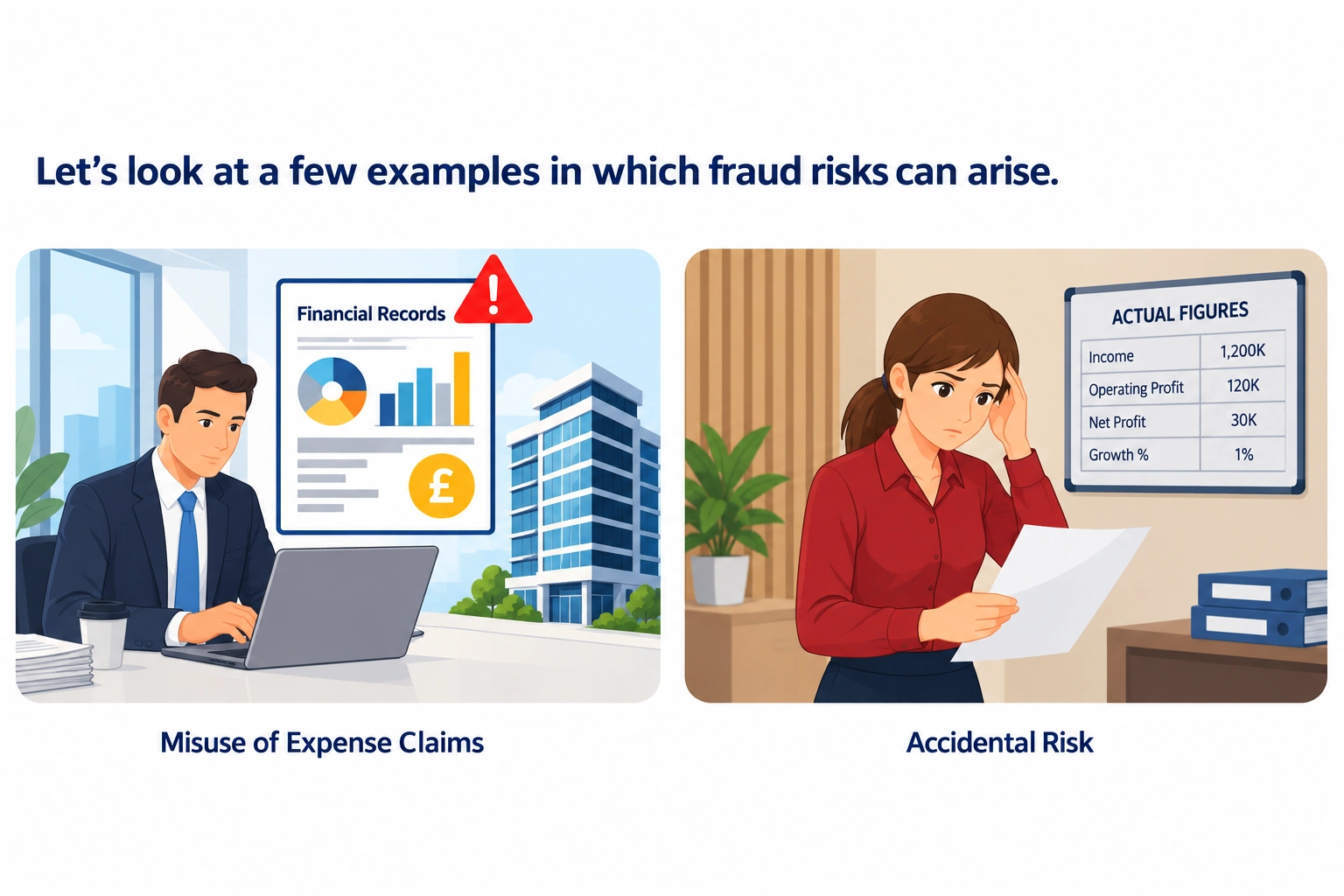
Financial figures, investor communications, external reports and supplier information can all create risk when facts are inaccurate, incomplete or misleading.
Commercial targets, fundraising pressure and tight deadlines can increase the importance of employees knowing when information needs to be checked or challenged.
Employees need to recognise inconsistencies, weak audit trails, unusual behaviour and resistance to reasonable questions.
Employees should understand that a concern does not need to be proven fraud before it is raised through the appropriate internal channel.
Fraud prevention is not only a concern for senior leaders, Compliance or Legal.
Employees across an organisation may create, review, communicate or rely on information that affects investors, financial records, suppliers and business decisions.
This course helps learners understand the Failure to Prevent Fraud context, recognise relevant warning signs and understand the importance of raising concerns when something appears unclear, unusual or suspicious.
Learners connect fraud-prevention principles with the information, behaviour and decisions they may encounter at work.
Understand why the corporate offence matters and how associated-person activity can create organisational exposure.
Identify behaviours including false representation, failure to disclose information and false accounting.
Notice inconsistent information, resistance to questions, unusual behaviour and weak documentation.
Recognise why relying on assumptions or unverified information can create risk.
Understand why early reporting is important and the internal channels that may be available.

Selected SucceedLEARN courses are CPD certified, helping learners build practical compliance knowledge while supporting continuing professional development.
*CPD certification applies to selected courses only.
The course reinforces that preventing and identifying fraud risk is not limited to senior management or control functions.
It is especially relevant where employees prepare, review, communicate or rely upon information that can influence investors, financial records, external reporting, suppliers or commercial decisions.
Fraud risk does not always start with an obvious act of misconduct. Learners should be alert to warning signs in information, behaviour and business processes.
Figures, explanations or supporting information do not align, or change without a clear reason.
Important decisions or communications depend on information that has not been independently corroborated.
Someone avoids reasonable scrutiny, becomes defensive or discourages further review.
Conduct appears inconsistent with expected standards, processes or organisational values.
Important decisions, adjustments or transactions lack appropriate records or supporting documentation.
Information, instructions or behaviour feels unusual, unclear or inconsistent with normal expectations.
The course reinforces prompt escalation where behaviour may involve fraud, misconduct or a breach of internal controls.
Early reporting gives the organisation an opportunity to understand the issue, investigate where necessary and take appropriate action.
Line manager Raise a concern through the appropriate management route.
Compliance or Legal Seek guidance where something may involve fraud, misconduct or an internal-control concern.
Speak-up or whistleblowing channel Use the organisation's established reporting process where appropriate.
Honesty, transparency, appropriate challenge and a willingness to raise concerns all contribute to an organisation's fraud-risk culture.
Key questions for Compliance, Risk, Legal and Learning & Development teams.
The Economic Crime and Corporate Transparency Act 2023 created a corporate Failure to Prevent Fraud offence. It can apply to large organisations where an associated person commits a specified fraud offence intending to benefit the organisation and reasonable fraud-prevention procedures were not in place.
The Failure to Prevent Fraud offence came into force on 1 September 2025.
Employees can influence information, financial records, reporting and commercial decisions. Government guidance on reasonable fraud-prevention procedures includes communication, including training, among its six principles.
Fraud prevention is relevant throughout an organisation. The course highlights Investment and Deal Teams, Finance and Fund Operations, external-reporting functions, Sales and Investor Relations, and Procurement and Third-Party Management as functions that should be particularly alert.
Examples include incomplete or inconsistent information, reliance on one source, resistance to questions, suspicious behaviour, missing documentation, weak audit trails and uncertainty about whether an action is appropriate.
The course reinforces early escalation. Employees should not wait until fraud has been conclusively proven before raising an appropriate concern.
See how Failure to Prevent Fraud training could support your organisation's financial crime prevention and employee-awareness programme.
Tell us a little about your organisation.