01
Anti-Money Laundering (AML)
Build awareness of money laundering risks, suspicious activity, customer due diligence, warning signs and appropriate escalation.
Explore More

Help employees recognise, resist and report bribery risks. Explore UK Bribery Act 2010 and US Foreign Corrupt Practices Act (FCPA) content in our UK ABAC course, alongside India-focused learning and options tailored to your organisation.


Build employee awareness across financial crime, ethical conduct and emerging compliance risks with practical, role-relevant eLearning.
Build awareness of money laundering risks, suspicious activity, customer due diligence, warning signs and appropriate escalation.
Explore MoreHelp employees recognise bribery and corruption risks involving gifts, hospitality, conflicts, third parties and improper influence.
Buy This CourseHelp employees recognise tax-evasion facilitation risks, suspicious conduct and situations requiring appropriate prevention or escalation.
Explore MoreBuild awareness around inside information, confidential information, improper disclosure and responsible handling of market-sensitive data.
Explore MoreHelp employees understand sanctions, restricted parties, high-risk jurisdictions, export controls and cross-border transaction risks.
Develop awareness of fraud risks, associated-person risk, warning signs, preventive actions and reporting responsibilities.
Explore MoreBuild employee awareness of modern slavery risks and potential concerns within business activities and supply-chain relationships.
Explore MoreHelp employees understand responsible workplace use of AI and the importance of applying organisational controls when using AI tools.
Explore More
Anti-Bribery and Anti-Corruption training teaches employees how to identify, prevent and report conduct intended to influence a business or official decision improperly.
A bribe is not limited to cash exchanged in secret. It can include an extravagant gift, a leisure trip, an unofficial payment, a disguised charitable donation, an excessive commission, a job offered to a decision-maker’s relative or another valuable advantage routed through a third party.
The risk often appears during ordinary business activity. An employee may be selecting a supplier, approving hospitality, appointing an agent, travelling through customs or discussing a new contract. The right response depends on the purpose, value, timing and transparency of the benefit, as well as applicable law and the organisation’s policy.
SucceedLEARN’s course uses short explanations, practical examples, decision activities and immediate feedback to help employees apply ABAC principles. Learners are encouraged to pause, check, document and report rather than make assumptions in a high-pressure situation.
Corporate bribery is not simply a legal issue. It undermines fair competition, weakens trust, creates operational disruption and can cause long-term reputational damage.
By the end of the course, learners will be able to explain corporate bribery, recognise common risk areas and respond in line with law and organisational policy.
Understand that a bribe may be financial or non-financial and can be offered, promised, given, requested or accepted.
Identify the main legal principles relevant to the chosen jurisdiction and understand why cross-border activity increases risk.
Distinguish reasonable, transparent business hospitality from excessive or improperly motivated benefits.
Follow internal approval, documentation, gifts, travel and reporting requirements consistently.
Spot risks involving third parties, donations, expenses, facilitation payments, nepotism and cronyism.
Refuse inappropriate requests, seek guidance and use the correct internal escalation channel without delay.
The course connects abstract rules to six familiar areas of work, helping employees identify warning signs before a decision becomes a breach.
Value, timing, frequency, purpose, approvals and accurate records.
Indirect payments, unusual commissions and associated-person exposure.
Reasonable business purpose, pre-approval, receipts and transparency.
Requests to speed up routine action and the correct response under policy and law.
Links to decision-makers, destination of funds and hidden commercial motives.
Employment or favours offered to influence or reward a business decision.
Learners follow Janet through immigration, a vendor meeting, a contract discussion and customs. At each point, they choose how to respond to a payment or benefit and receive immediate feedback.

Applying ABAC decisions during business travel.

Deciding which business gifts may be accepted.

Legal context across jurisdictions.
Corporate bribery, corruption and their impact.
Relevant laws and organisational policy.
Gifts, hospitality and third-party scenarios.
Refusal, escalation and reporting actions.
Final assessment and CPD certificate.

The course is suitable for employees, managers and relevant contractors, with particular value for people who interact with suppliers, intermediaries, clients or public officials, approve expenses or influence commercial decisions.
Explore the legal context behind the course content, in UK, US and India order.
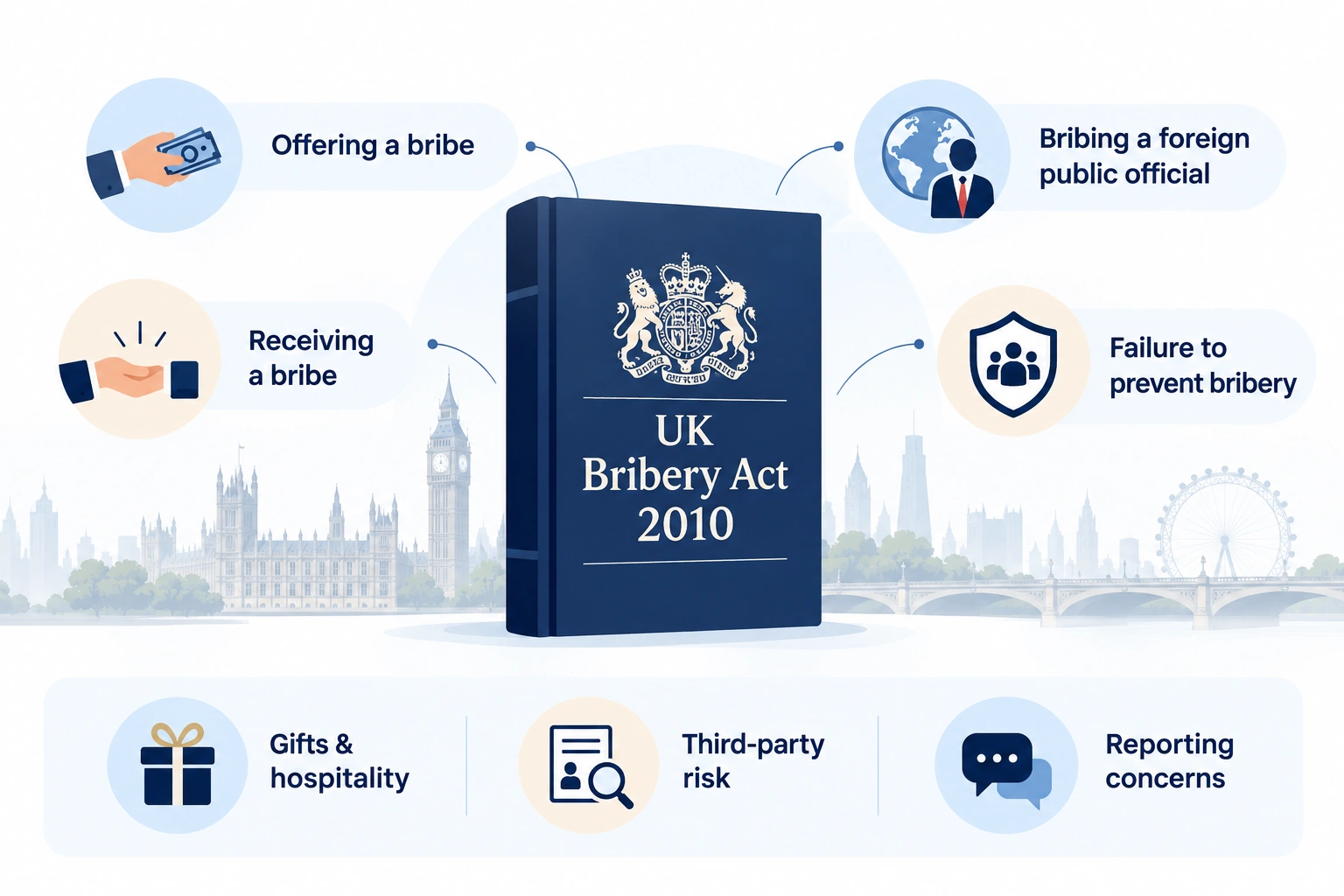
The Bribery Act 2010 covers offering or giving bribes, requesting or accepting bribes, bribery of foreign public officials and failure by commercial organisations to prevent bribery by associated persons.
The adequate-procedures defence relates to the corporate failure-to-prevent offence. Ministry of Justice guidance sets out six principles: proportionate procedures, top-level commitment, risk assessment, due diligence, communication including training, and monitoring and review.
Where useful for international business, the course contrasts the UK approach with the US Foreign Corrupt Practices Act, including the different treatment of facilitation payments.

The FCPA prohibits covered individuals and businesses from bribing foreign officials to obtain or retain business. It also contains accounting requirements for issuers, including books and records and internal accounting controls.
Its narrow exception for certain routine governmental action does not make facilitation payments universally lawful. The UK Bribery Act has no equivalent exception, and organisational policy may prohibit such payments.
The UK ABAC course introduces the FCPA alongside UK law to support awareness of cross-border bribery risks.
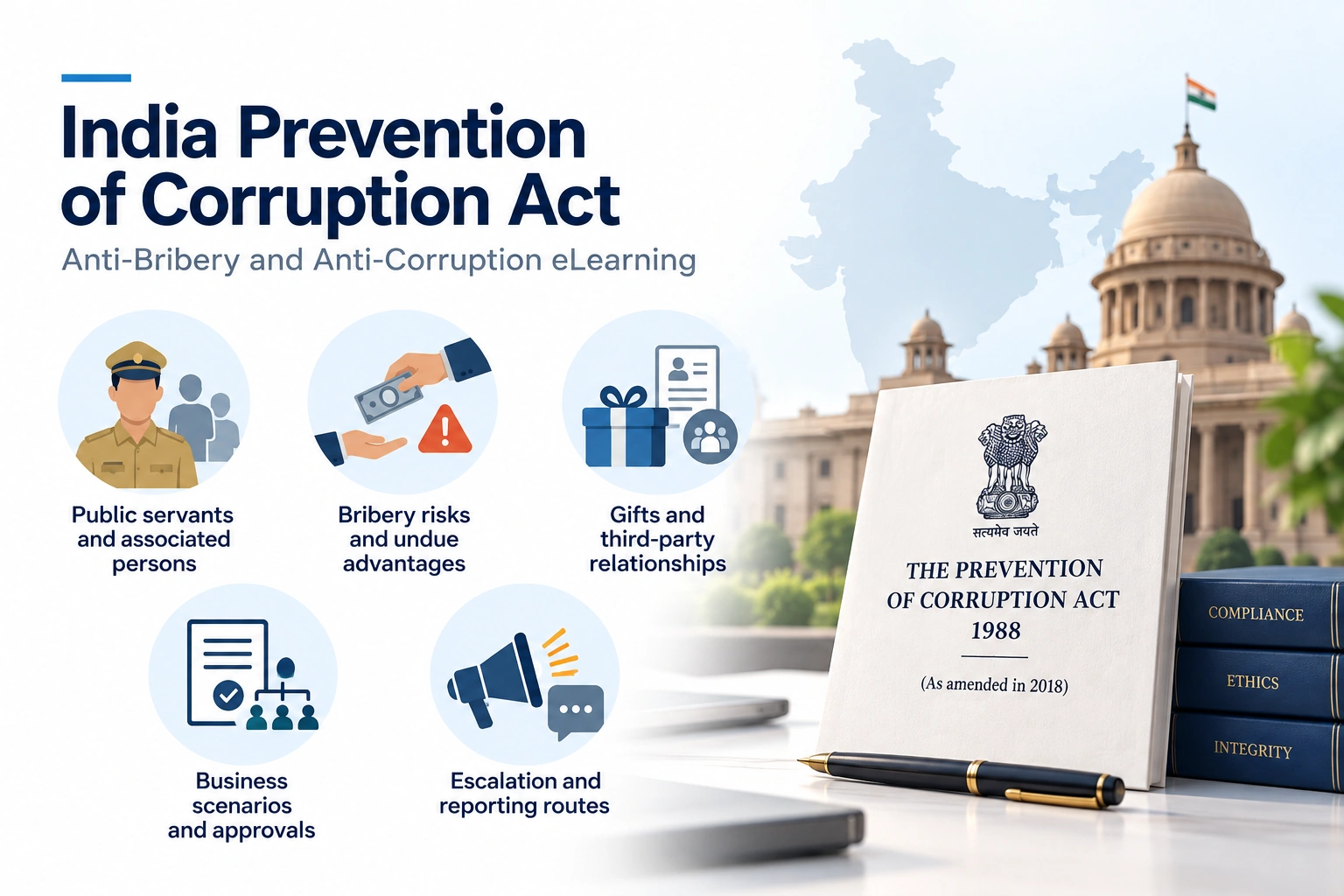
The India-focused course covers the Prevention of Corruption Act 1988, including changes introduced by the 2018 amendment. It explains bribery involving public servants and the giving or promising of an undue advantage.
It introduces the offence relating to bribery of a public servant by a commercial organisation, the role of associated persons and potential liability for persons in charge where the statutory conditions are met.
The content can also be aligned with the organisation’s Code of Conduct, gifts and hospitality policy, whistleblowing process and internal approval controls.
Selected SucceedLEARN courses are CPD certified, helping learners build practical compliance knowledge while supporting continuing professional development.
*CPD certification applies to selected courses only.
Answers to common questions about ABAC training, course content, legal context, delivery and customisation.
Speak to a specialistABAC means Anti-Bribery and Anti-Corruption. It covers the rules, controls and behaviours used to prevent improper influence in business and public-sector dealings.
It is workplace training that helps employees recognise, prevent and report bribery and corruption risks in everyday business decisions.
Employees, managers and relevant contractors should take it, especially anyone dealing with suppliers, customers, agents, expenses, gifts, hospitality or public officials.
The UK ABAC course covers the UK Bribery Act 2010 (BA 2010) and introduces the US Foreign Corrupt Practices Act (FCPA) for international business context.
The course covers gifts and hospitality, third parties, travel and entertainment, charitable donations, facilitation payments, nepotism, cronyism, approvals and reporting.
No. Genuine, proportionate and transparent business hospitality may be permitted, subject to applicable law and the organisation’s approval and record-keeping rules.
Yes. The UK ABAC course is CPD certified.
The course takes approximately 30 minutes and includes practical scenarios, knowledge checks and a final assessment.
It can be delivered through the SucceedLEARN SaaS platform or as a SCORM package for a compatible learning management system.
Yes. Policy wording, reporting routes, gift limits, branding, jurisdictions and workplace scenarios can be tailored to the organisation’s needs. ABAC forms part of a wider customisable course range.
The Foreign Corrupt Practices Act is a US law addressing bribery of foreign officials. It also sets accounting requirements for issuers. FCPA content is included in the UK ABAC course.
The India-focused course covers the Prevention of Corruption Act 1988, including the 2018 amendments, with scenarios involving public servants, undue advantages and business conduct.
Tell us about your UK Bribery Act, US FCPA or India ABAC training needs. We can discuss the appropriate course, delivery option and any customisation required for your organisation.
Explore scenarios, interactions and assessment style.
Cover jurisdictions, policies, delivery and customisation.
Choose SucceedLEARN SaaS or a SCORM package.