
- Engaging animated explainers
- Concise, voice-narrated slide content
- Hands-on, scenario-based interactions
- Practical, real-world workplace examples
- Regular quizzes to reinforce learning
- A final evaluation with certificate issuance

Learning Objectives
By the end of this course, learners will be able to:
- Understand the structure and removal process of an Internal Committee.
- State who can file a complaint and against whom it can be filed.
- List the timelines and procedure to be followed for inquiry and conciliation.
- State the guidelines for preparing an inquiry and actions report that the IC can recommend (in case the complaint is found to be either genuine or malicious).
- List the roles and responsibilities of the Internal Committee.
Why Prevention of Sexual Harassment Internal Committee Training?
Legal Compliance Requirement - Mandatory under the POSH Act, 2013
Any organisation with 10 or more employees must constitute an Internal Committee (IC) and ensure sexual harassment matters are addressed internally. The training helps organisations fulfil this statutory requirement, avoid procedural lapses, and demonstrate due diligence. Non-compliance can lead to heavy fines, and even cancellation of business licence.
Prevents Legal, Financial & Reputational Damage
Without proper training, IC members or management may mishandle complaints, miss timelines, or breach confidentiality. Since the law mandates timelines for complaint handling, inquiry closure, reporting and confidentiality, training helps protect the organisation from penalties and reputational fallout and demonstrate compliance.
Builds a Skilled & Legally Knowledgeable Internal Committee (IC)
IC members learn roles, responsibilities, how to handle the issue sensitively while encouraging the victim to file a complaint, inquiry powers similar to a civil court, conciliation procedures, report drafting and enquiry timelines. This enables fair, unbiased investigations and proper documentation something that is crucial in court scrutiny.
Supports Prevention, Not Just Response
POSH compliance is more than receiving complaints. The Internal Committee must also conduct awareness initiatives and preventive programs such as brown-bag meetings, Diversity and Inclusion activities, posters, communication drives, reducing incident occurrence.
Training Designed for Real-world Workplace Scenarios
The course goes beyond textbook definitions by including situations involving office premises, work-from-home settings, business travel, conferences, offsites, parties, WhatsApp, email and social media interactions, preparing employees for modern work environments, thereby raising awareness on all the different ways where employees could be subjected to sexual harassment.
Interactive, Engaging and Application-Focused Learning
Learners connect deeply through drag and drop activities, case examples, role-based scenarios, knowledge checks and assessments thus ensuring retention, behaviour change and practical understanding rather than passive viewing.
Assessment and Completion Certificate Included
Demonstrates that employees have been trained thereby supporting compliance records, audit trails and defending the organisation’s preparedness in case of legal proceedings.
Optimised for Global and Distributed Teams
Accessible anywhere, anytime, being mobile-friendly, with flexible rollout for hybrid or multi-location organisations.
Laws & Regulations Addressed in POSH Internal Committee Training
| Legislation / Concept | Relevance in the Course |
|---|---|
| Sexual Harassment of Women at the Workplace (Prevention, Prohibition and Redressal) Act, 2013 (Law) - POSH Act | The course aligns with the POSH Act by covering in depth the roles and responsibilities of the IC Members, how to handle complaints, raise awareness, and prevent legal consequences. |
Course's Screenshots
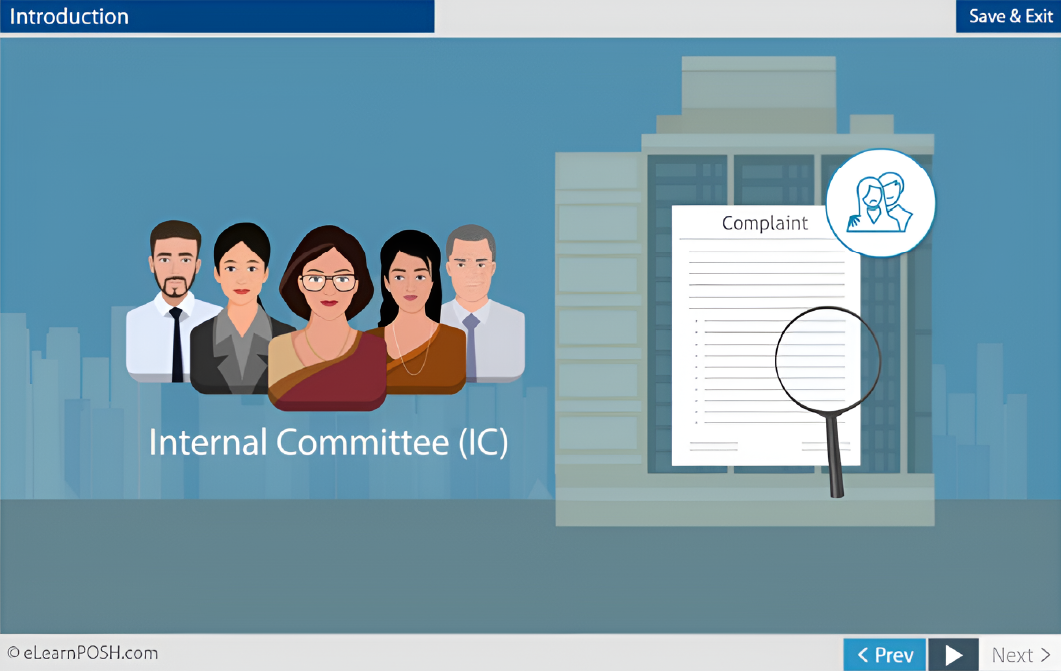
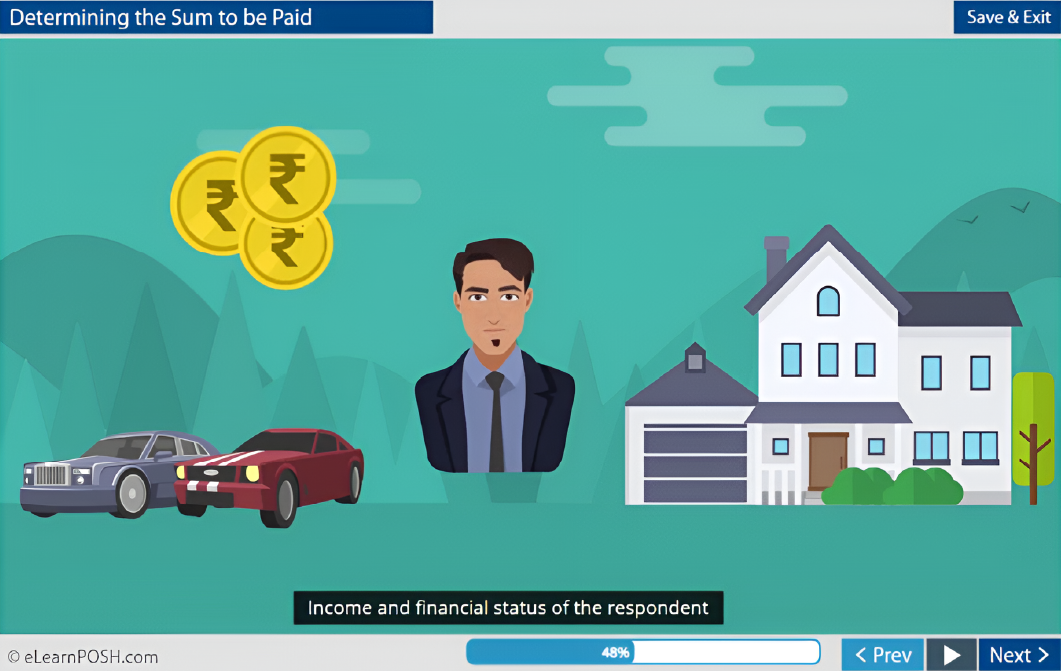
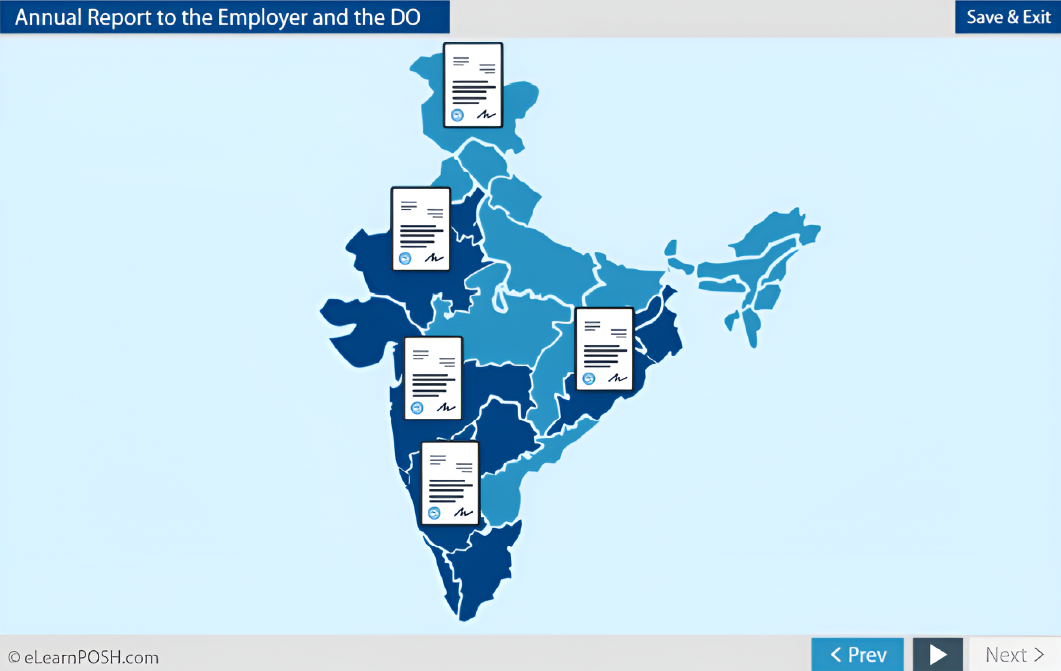
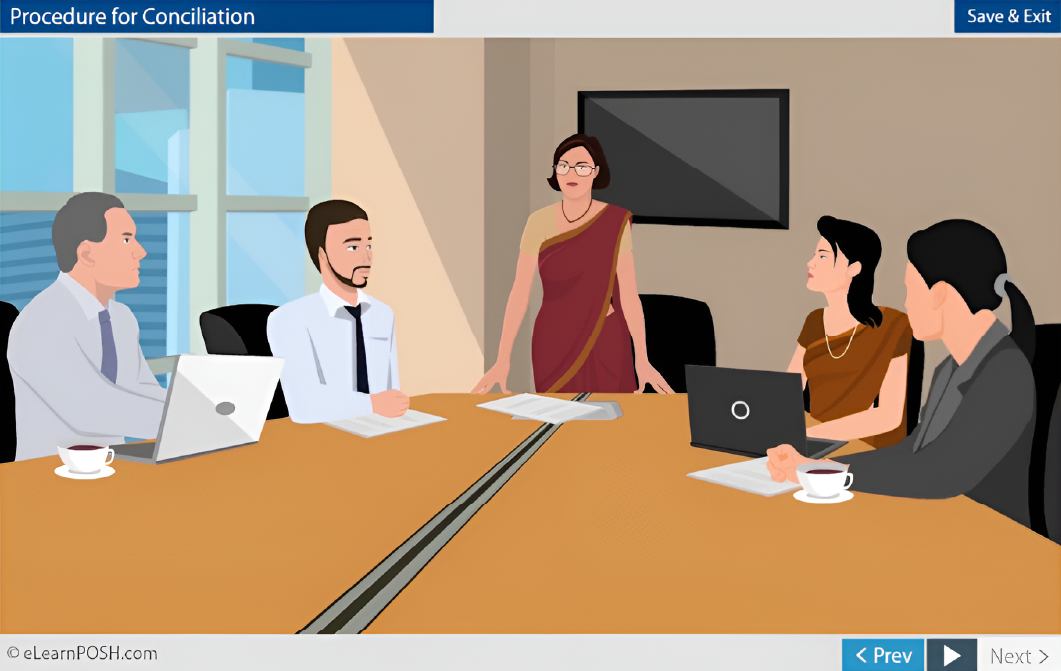

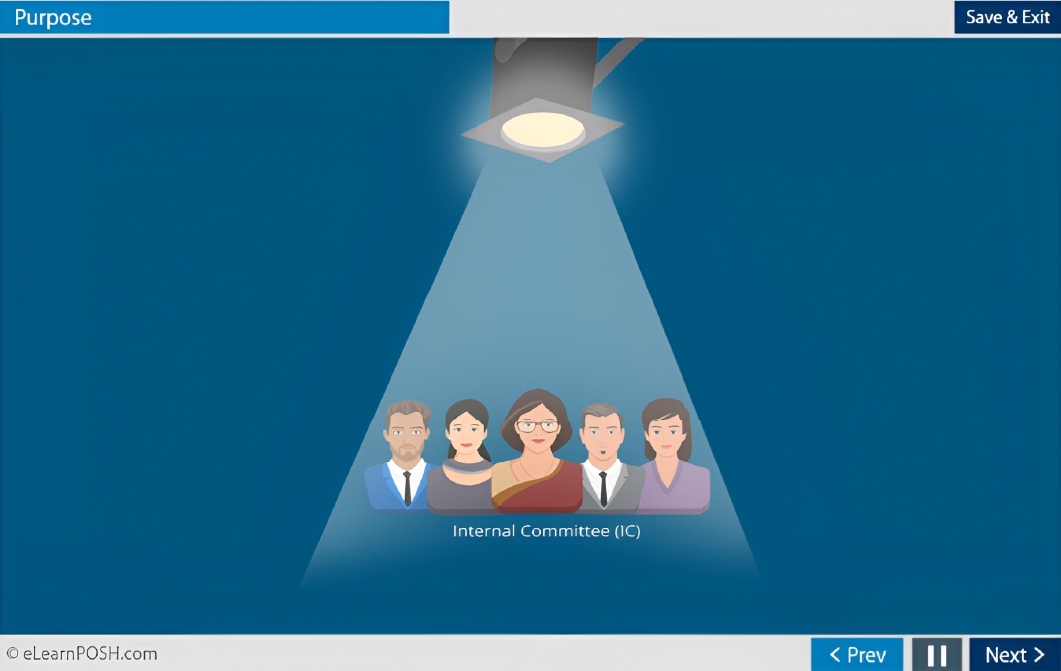
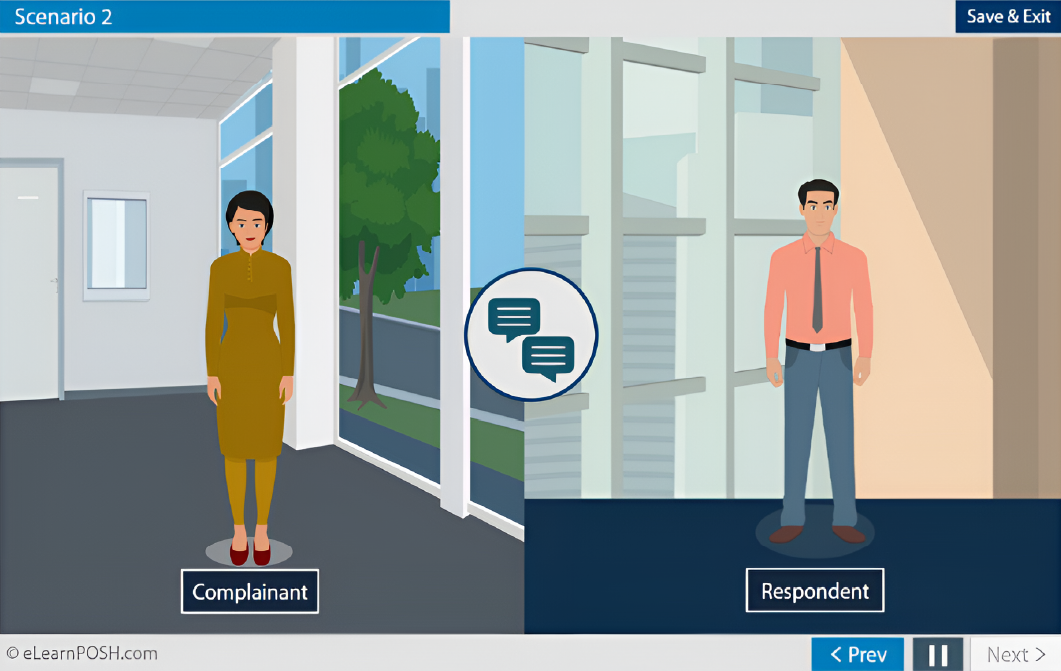


Course Structure
Learning elements
Format & accessibility
The platform offers fully responsive design across desktop, tablet, and mobile, along with a learner dashboard, progress tracking, and employee reminders.
Certificate
On successful completion and passing the assessment, learners can generate a completion certificate as proof of training (configurable per org).
Target Audience
The course is tailored for all Internal Committee (IC) members.
Case Studies: Real Consequences of Non-Compliance
Law provides that an organisation with ten or more employees must constitute an Internal Committee (IC), which can inquire into Complaints of Sexual Harassment within the organisation. The constitution of an IC is a legal compliance requirement under the Sexual Harassment of Women at the Workplace (Prevention, Prohibition and Redressal) Act, 2013 (Law). This is mandatory and if not complied shall attract heavy fines including cancellation of licence to do business.
Following are a few cases where organisations faced severe penalties for non-compliance:
- Standard Chartered Bank IC Inquiry Challenged in Tribunal
In a case involving Standard Chartered Bank, the Internal Committee’s conduct of a POSH inquiry was challenged on procedural grounds: The IC found the respondent guilty but did not pass any punishment or compensation. The complainant appealed the IC’s decision, alleging arbitrary procedure, lack of natural justice, and confidentiality breaches (e.g., anonymous witnesses and disclosure issues).This led to litigation before an appropriate forum, showing that poorly executed inquiry processes can lead to legal appeals and organisational burden.
- High Court challenge due to improper IC processes
In Ms (X) vs Internal Complaints Committee & ANI Technologies Pvt Ltd (Karnataka HC writ petition, September 2024), the petitioner challenged the IC and employer on procedural grounds before the High Court. The case involved disputes around the IC’s handling of the complaint and was significant enough to be brought before the High Court, underscoring that failures in IC procedure can result in litigation against the employer.
Course Outline
Structure of the IC and Removal of Members
Jurisdiction of IC
Sexual Connotation in Harassment and Discrimination
Redressal Mechanisms
Conciliation
Principles of Natural Justice
Inquiry Process
Interim Measures
Findings and Report Drafting
Annual Report Filing
FAQs
An Internal Committee (IC) is a mandatory body that employers in India must constitute under the Sexual Harassment of Women at Workplace (Prevention, Prohibition and Redressal) Act, 2013 to receive, inquire into, and resolve sexual harassment complaints at the workplace. For employers with 10 or more employees, having a properly constituted IC is a statutory compliance requirement and a key mechanism to demonstrate reasonable steps, due process, and zero tolerance towards workplace sexual harassment.
It is a complete training solution that equips Internal Committee members with the knowledge and skills required under the POSH Act. The program includes eLearning modules and resources to help organisations stay compliant.
IC members, HR and People Ops teams, External Members, and anyone involved in POSH compliance or inquiry processes within an organization.
A POSH IC program typically includes IC training materials, POSH policy and inquiry templates, legal reference guides, and standard operating procedures. It also provides mandatory workplace posters, District Officer and Local Committee contact lists, IC Meetings Minutes Register, case documentation formats, drafting tools, timelines and compliance checklists, POSH Audit Tool, Complaints Management System, Knowledge Base, webinar library, anonymised case studies for training, and access to expert guidance, ensuring statutory visibility, procedural consistency, and audit-ready compliance under the POSH Act.
The eLearning module is approximately 2 Hrs 50 Mins long. New micro-modules and legal updates are periodically added.
Under the POSH Act, any organisation with 10 or more employees is legally required to constitute an IC.
An Internal Committee (IC) is constituted by the employer, and has the following people as the members:
- Presiding Officer, who heads the committee.
- At least two Members from amongst employees.
- At least One external member from amongst non-governmental organisations or associations.
The Presiding officer is a woman employee at a senior level at the workplace.
Members from amongst employees should preferably be committed to the cause of women or have experience in social work or possess legal knowledge.
The external member needs to be committed to the cause of women, or someone familiar with the issues relating to sexual harassment and must be independent and unrelated to the organisation.
Yes, IC must accept complaints from employees, interns, contract workers, and others working in the organisation.
Under the POSH framework, the respondent is entitled to a fair and unbiased inquiry. Key rights include:
- Right to be informed of the allegations and provided a copy of the complaint.
- Right to a fair hearing, including the opportunity to present their version of events.
- Right to respond in writing and submit supporting evidence and witnesses.
- Right to cross-examine the complainant and witnesses, in line with IC procedures.
- Right to confidentiality, with identity and inquiry details protected throughout the process.
- Right to impartial inquiry, conducted without bias or presumption of guilt.
- Right to reasoned findings, with recommendations based solely on evidence.
- Right to appeal against the IC’s recommendations, as permitted under service rules or applicable law.
These safeguards ensure that while complaints are addressed seriously, principles of natural justice are upheld for all parties involved.
After completing the inquiry, the IC submits a written report within 10 days to the employer (or District Officer), with copies shared with both the complainant and the respondent. If sexual harassment is not proved, no action is recommended. If it is proved, the IC recommends appropriate disciplinary action and may also suggest compensation to the aggrieved woman which may be recovered by deducting from the respondent’s salary or, if that’s not feasible, directly from the respondent. If the respondent fails to pay, the sum may be recovered as land revenue.
The employer or District Officer must implement the recommendations within 60 days. In cases of malicious or knowingly false complaints, the IC may recommend action against the complainant as per applicable rules.
After concluding the inquiry, the Internal Committee (IC) submits its report to the employer with clear recommendations. These may include:
- Disciplinary action against the respondent, proportionate to the gravity of the misconduct.
- Monetary compensation to the aggrieved woman for harm suffered, including mental trauma, loss of career opportunity, or medical expenses.
- Action against the complainant only if the complaint is proven to be deliberately false or malicious (mere lack of proof does not qualify).
Yes. The POSH Act mandates strict confidentiality throughout the process. Details of the complaint, the identities and addresses of the aggrieved woman, respondent, and witnesses, as well as information relating to conciliation, inquiry proceedings, recommendations, and actions taken, must not be disclosed to the public, press, or media.
If proven malicious after inquiry, IC may recommend action against the complainant. The good faith complaints are protected.
External IC member provides independent oversight, expertise, and ensures neutrality during cases.
An annual report is a compulsory report that summarises complaints received, resolved, pending cases and preventive efforts. It must be submitted to the District Officer annually to maintain compliance.
We offer a seamless SaaS-based hosting option for easy access and deployment.
