

Security Awareness Training
Build practical awareness of cyber security, information protection and safer employee behaviours.
Explore More →

Help investment teams recognise when political activity can create compliance, anti-bribery, conflict of interest or cross-border regulatory risk.
This practical SucceedLEARN course combines investment-sector scenarios with UK political donations considerations and US Pay-to-Play awareness.
A focused learning experience for professionals who want practical political donations awareness without a lengthy training commitment.
Deliver political donations awareness across teams while giving administrators the controls needed to assign training, monitor completion and manage recurring compliance activity.
Extend political donations awareness into a broader compliance programme covering cyber security, code of conduct, financial crime and regulated-firm responsibilities.
Build practical awareness of cyber security, information protection and safer employee behaviours.
Explore More →Reinforce phishing awareness through realistic simulation exercises.
Explore More →Strengthen responsible handling of personal information and privacy awareness.
Explore More →Build awareness of workplace conduct and appropriate employee responsibilities.
Explore More →KYC, CDD, EDD, MLRO, CFT, CPF and practical financial crime awareness.
Explore More →Understand compliance considerations involving gifts, hospitality and entertainment.
Explore More →Build awareness of speaking up and appropriate reporting channels.
Explore More →Awareness of political donations within organisational governance and compliance.
Explore More →Employee-focused awareness of SMCR and regulated-firm conduct responsibilities.
Explore More →Senior-manager awareness of SMCR, accountability and regulatory responsibilities.
Explore More →Access the wider Financial Crime Prevention learning range as part of the broader PE/VC compliance proposition.
Explore More →
Selected SucceedLEARN courses are CPD certified, helping learners build practical compliance knowledge while supporting continuing professional development.
*CPD certification applies to selected courses only.
Political contributions compliance training helps employees recognise activities that may create regulatory, anti-bribery, conflict of interest or reputational risk.
The course focuses on situations relevant to investment professionals, including monetary contributions, fundraising, in-kind support, professional titles, political events and organisational endorsement.
Learners are encouraged to recognise risk early and understand when firm policy, internal approval or Compliance input may be relevant.
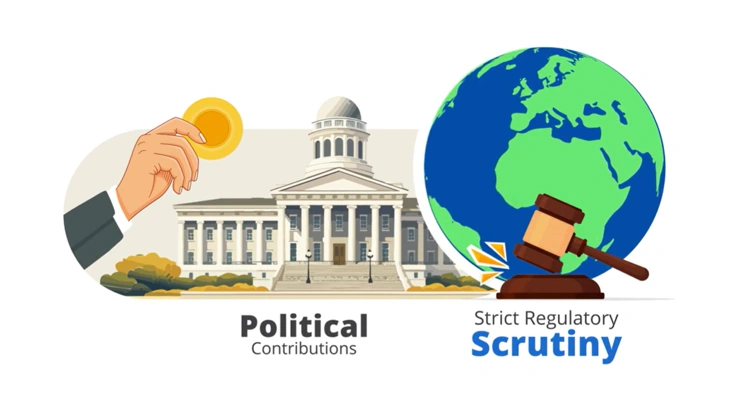
Investment firms operating across jurisdictions may need to consider both UK political contribution controls and US Pay-to-Play requirements.

Relevant considerations can include company law, political finance requirements, anti-bribery risk, FCA expectations and internal firm policies.

International investment firms may need to consider political contribution restrictions where government investment advisory business is involved.
The course helps learners move from basic awareness to practical decision-making around political activity and professional identity.
Identify anti-bribery, conflict of interest, regulatory and reputational considerations.
Consider financial contributions, sponsorship, fundraising, facilities and in-kind support.
Understand how titles, firm names and public visibility can change the compliance context.
Recognise when escalation, reporting or Compliance input may be appropriate.
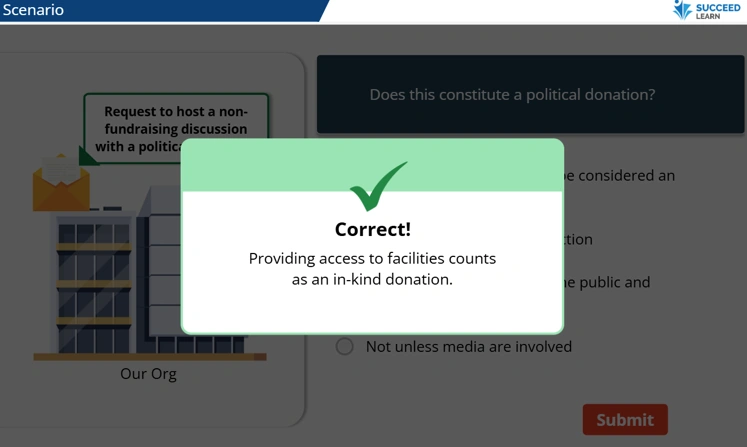
Visual explanations and practical scenarios help learners understand how political activity can become a compliance issue.

Regulatory scrutiny and political contribution risk

Monetary and in-kind political support

Internal approval and compliance pre-clearance
The course uses situations relevant to investment professionals so learners can apply compliance principles rather than simply memorise policy.
This course is relevant to professionals whose role may intersect with political, public-sector, investor or portfolio-company relationships.
Specialist compliance training works best when learners can see how the topic applies to their actual working environment.
PE/VC situations are used instead of generic corporate examples.
Learners see both domestic and cross-border compliance considerations.
Employees apply principles to practical decisions.
Complex political contribution risks are explained concisely.
Political donations training helps employees recognise political activity that may create regulatory, anti-bribery, conflict of interest or reputational risk.
Political donations can include monetary contributions, fundraising participation, sponsorship, facilities, services and in-kind support depending on the circumstances.
Investment firms may interact with investors, public bodies, portfolio companies and government-linked stakeholders, creating additional influence and conflict risks.
Yes. Risk can arise where an employee's professional title, organisation name, business access or firm resources are visible.
Yes. The course introduces UK political donations and anti-bribery considerations alongside US Pay-to-Play issues relevant to internationally active investment firms.
Yes. A professional title can make personal political activity appear connected with the organisation and may create perceived endorsement.
Depending on the circumstances, providing facilities, services or organisational resources can constitute in-kind political support.
It is relevant to investment teams, managers, executives, portfolio-facing professionals and Compliance, Legal and Risk functions.
Pay-to-Play describes concerns around political contributions being connected with obtaining or retaining government investment advisory business.
Training helps employees recognise risks early, follow internal approval procedures and reduce compliance, conflict and reputational exposure.
Give your investment professionals practical training on political contribution risk, anti-bribery considerations and cross-border compliance.
Complete the form to discuss your organisation's course requirements.