Protect Patient Confidentiality
Understand the importance of safeguarding patient information against inappropriate access, use and disclosure.


Protecting patient information is a fundamental responsibility across healthcare organizations. From accessing medical records to communicating patient information, employees must understand how the Health Insurance Portability and Accountability Act (HIPAA) applies to their everyday responsibilities.
SucceedLEARN's HIPAA Awareness Training for Covered Entities helps healthcare professionals understand the HIPAA Privacy, Security and Breach Notification Rules through interactive learning and practical healthcare scenarios.
The course covers the responsible handling of Protected Health Information (PHI), patient rights, security safeguards and the identification and reporting of potential HIPAA violations.
In healthcare, protecting patient information is essential to maintaining trust and delivering responsible care. With personal health information moving across multiple departments, systems and services, organizations need a consistent approach to data protection.
HIPAA awareness training helps establish this foundation by connecting regulatory expectations with everyday workplace responsibilities and encouraging a culture of privacy and accountability.
Understand the importance of safeguarding patient information against inappropriate access, use and disclosure.
recognize patients' rights concerning their health information and the responsibilities associated with responding to information requests.
Build awareness of risks involving electronic health records, mobile devices, email, messaging and other communication channels.
Understand how inappropriate information handling can lead to privacy breaches, regulatory consequences and loss of patient trust.
By strengthening employee awareness, healthcare organizations can reinforce responsible information handling and support their broader HIPAA compliance efforts.
The training introduces the fundamental HIPAA requirements and helps employees recognize how they apply to common healthcare situations.
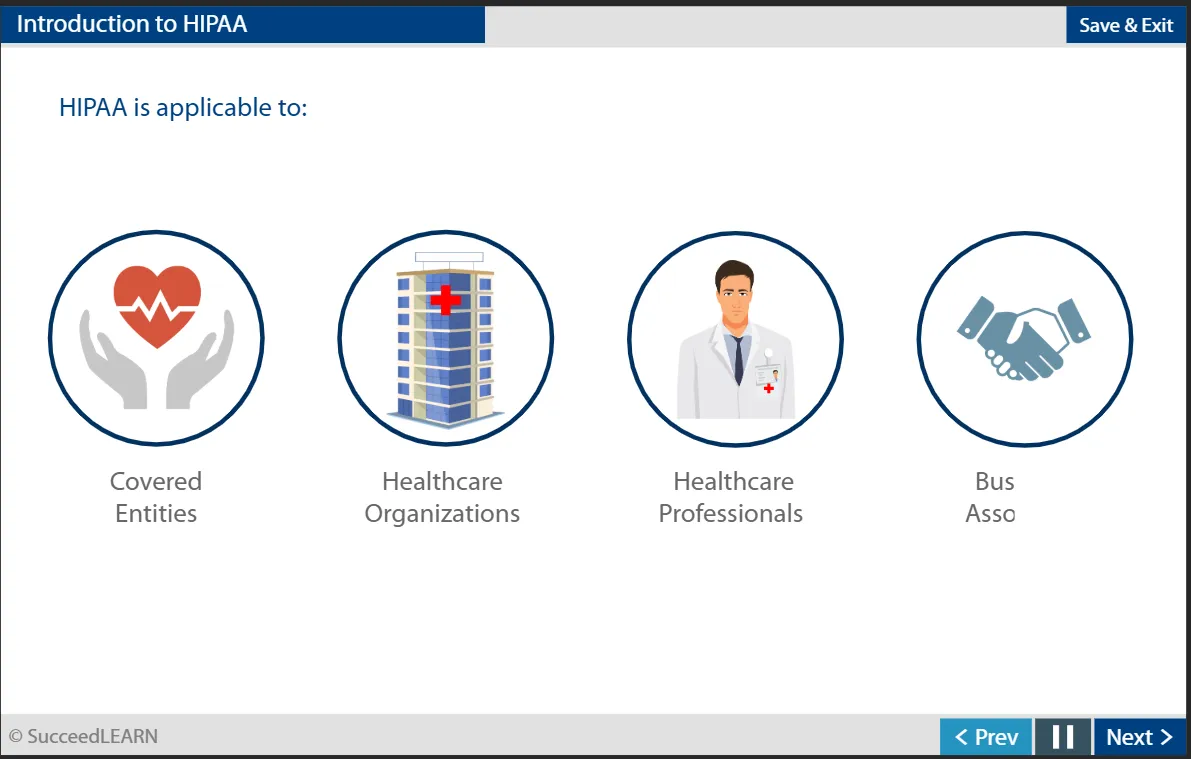
Identify what constitutes PHI, understand the scope of HIPAA and recognize the responsibilities of Covered Entities and Business Associates.
Understand when patient information may be used or disclosed, when authorization is required and how the minimum necessary principle applies.
Learn about patients' rights to access, amend and request restrictions on their health information, along with other privacy-related rights.
Recognize the importance of safeguarding electronic PHI through appropriate security measures and responsible use of devices and communication systems.
Understand the consequences of HIPAA violations, recognize potential breaches and become familiar with breach notification responsibilities.
The Health Insurance Portability and Accountability Act of 1996 (HIPAA) establishes requirements for protecting health information and defines responsibilities for Covered Entities and applicable Business Associates.
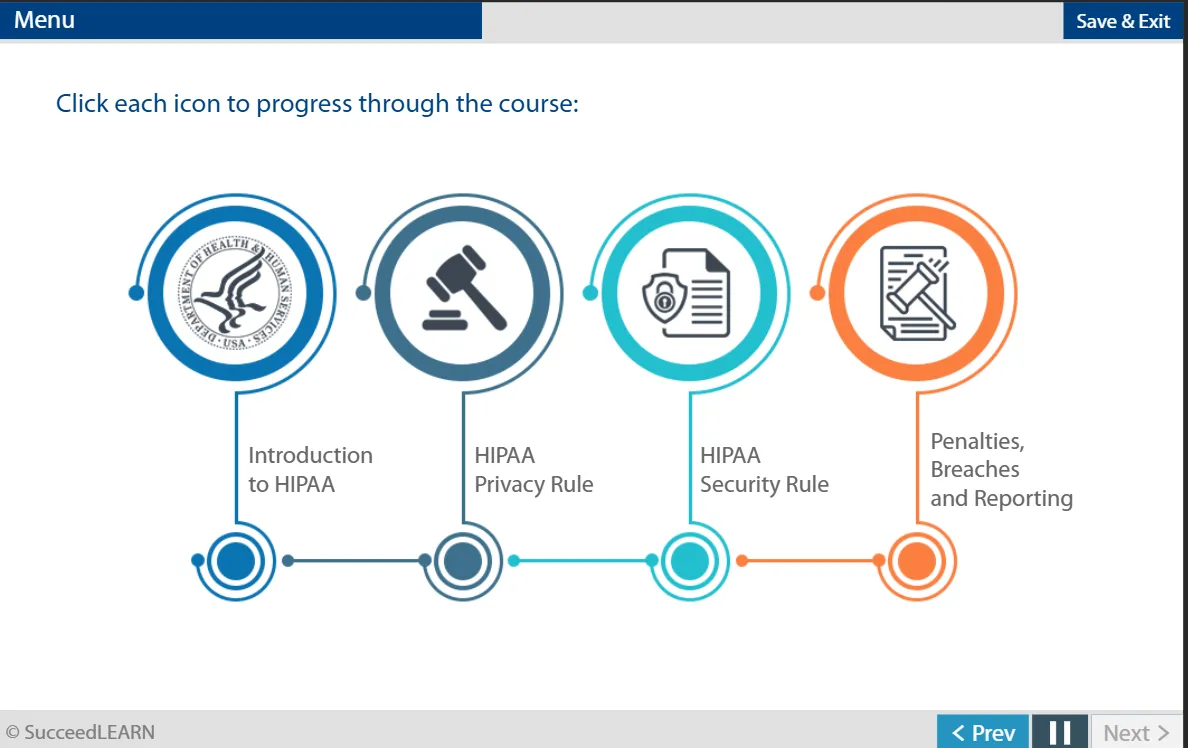
The course introduces three principal HIPAA rules.
| HIPAA Rule | Coverage in the Training |
|---|---|
| HIPAA Privacy Rule | Standards governing the use and disclosure of Protected Health Information, patient authorization, permitted disclosures and individual privacy rights. |
| HIPAA Security Rule | Safeguards for protecting the confidentiality, integrity and availability of electronic Protected Health Information (ePHI). |
| HIPAA Breach Notification Rule | Requirements relating to breaches of unsecured PHI, breach assessment and notification responsibilities. |
The course also introduces the role of the U.S. Department of Health and Human Services (HHS) and the Office for Civil Rights (OCR) in HIPAA enforcement.
Structured lessons introduce the core HIPAA requirements through explanations and guided learning activities.
Practical situations involving patients, healthcare professionals and administrative personnel illustrate privacy and security responsibilities.
Employees evaluate workplace situations, identify potential violations and select appropriate responses.
An end-of-course assessment helps evaluate understanding of the key concepts covered in the training.
Fully responsive interface across desktop, tablet, and mobile, complete with a learner dashboard, progress tracking, automated reminder prompts, and seamless integration with your existing LMS or HR systems.
Upon successful completion, you receive a CPD certificate valid as proof of training.
The course uses interactive activities and real-world healthcare situations to help employees understand how HIPAA requirements apply to their daily responsibilities.
Rather than relying entirely on regulatory explanations, learners encounter scenarios involving patient information requests, inappropriate disclosures, electronic communications and information security decisions.
Request a Demo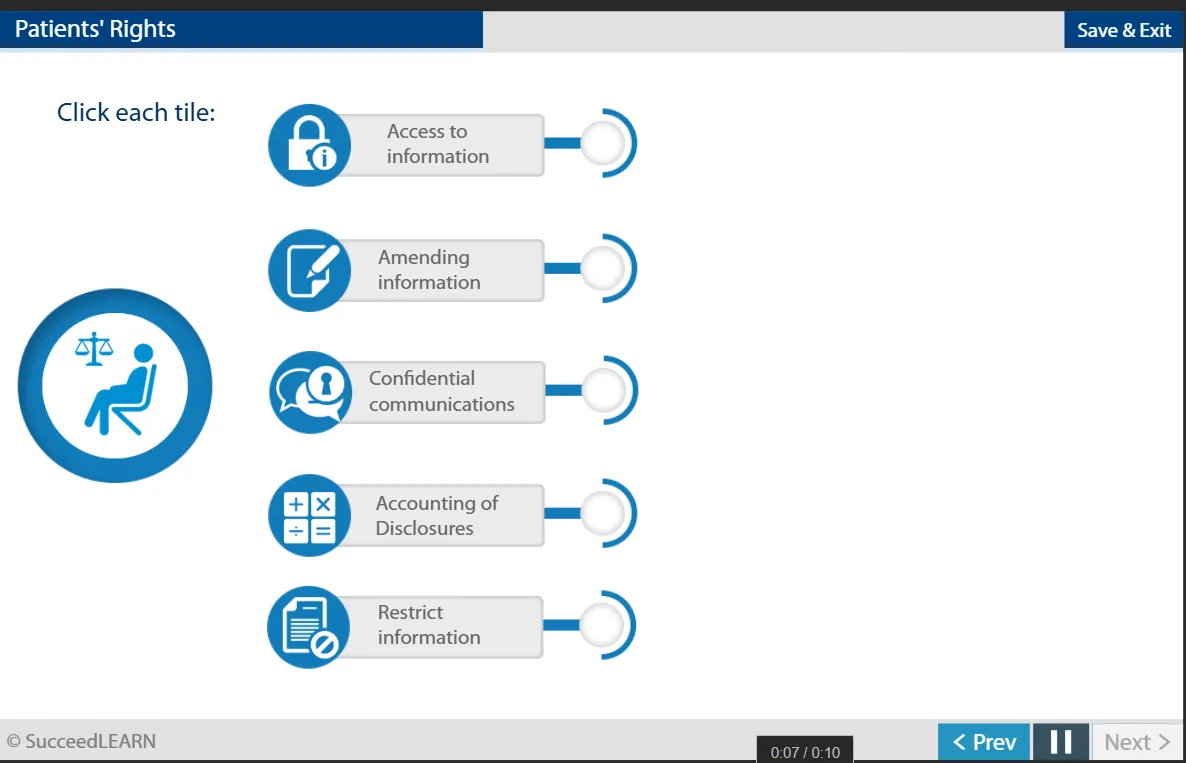
The course uses situations involving healthcare professionals, patients and administrative employees to make HIPAA concepts relevant to workplace responsibilities.
Interactive activities help employees recognize potential violations and understand the implications of different decisions.
The training introduces the Privacy Rule, Security Rule and Breach Notification Rule within one structured learning experience.
Employees learn about patient records, information disclosures, mobile devices and electronic communications.
An end-of-course assessment helps evaluate employees' understanding of the principal HIPAA concepts.
The course is suitable for healthcare professionals and other workforce members who access, handle, process, maintain or protect patient information as part of their responsibilities.
The course is particularly relevant to healthcare-provider environments and can support broader workforce awareness programs within applicable Covered Entities.
HIPAA Awareness Training for Covered Entities helps employees understand the privacy, security and breach notification responsibilities associated with handling Protected Health Information under HIPAA.
HIPAA Covered Entities include health plans, healthcare clearinghouses and healthcare providers that transmit health information electronically in connection with certain covered transactions.
Relevant workforce members of HIPAA Covered Entities should receive training appropriate to their responsibilities. This may include clinical, administrative, technical and operational employees who handle patient information.
The course covers HIPAA fundamentals, Protected Health Information, the Privacy Rule, Security Rule, patient rights, information security practices, HIPAA violations, breaches and reporting responsibilities.
Yes. The course introduces patient authorization, permitted disclosures, the minimum necessary principle, individual rights and Notice of Privacy Practices.
Yes. Employees learn about security safeguards for electronic PHI, along with practical considerations involving mobile devices, email, messaging and electronic patient information.
Yes. The training introduces potential breaches, secured and unsecured PHI, breach assessment and notification responsibilities.
Yes. The training includes interactive scenarios involving patient information requests, inappropriate disclosures, marketing-related requests and electronic communications.
Yes. The course is relevant to administrative and operational employees whose responsibilities involve accessing, processing or handling patient information.
The HIPAA Privacy Rule requires Covered Entities to train workforce members on applicable privacy policies and procedures. The HIPAA Security Rule also establishes security awareness and training requirements for covered entities and business associates, as applicable.
Yes. The course can be incorporated into employee onboarding and ongoing awareness programs, depending on an organization's training requirements.
No. Training supports workforce awareness, but HIPAA compliance also involves appropriate policies, safeguards, risk management and other organizational responsibilities.