- Short, narrated slides explaining key ABAC concepts
- Interactive “click to explore” map of major global ABAC laws
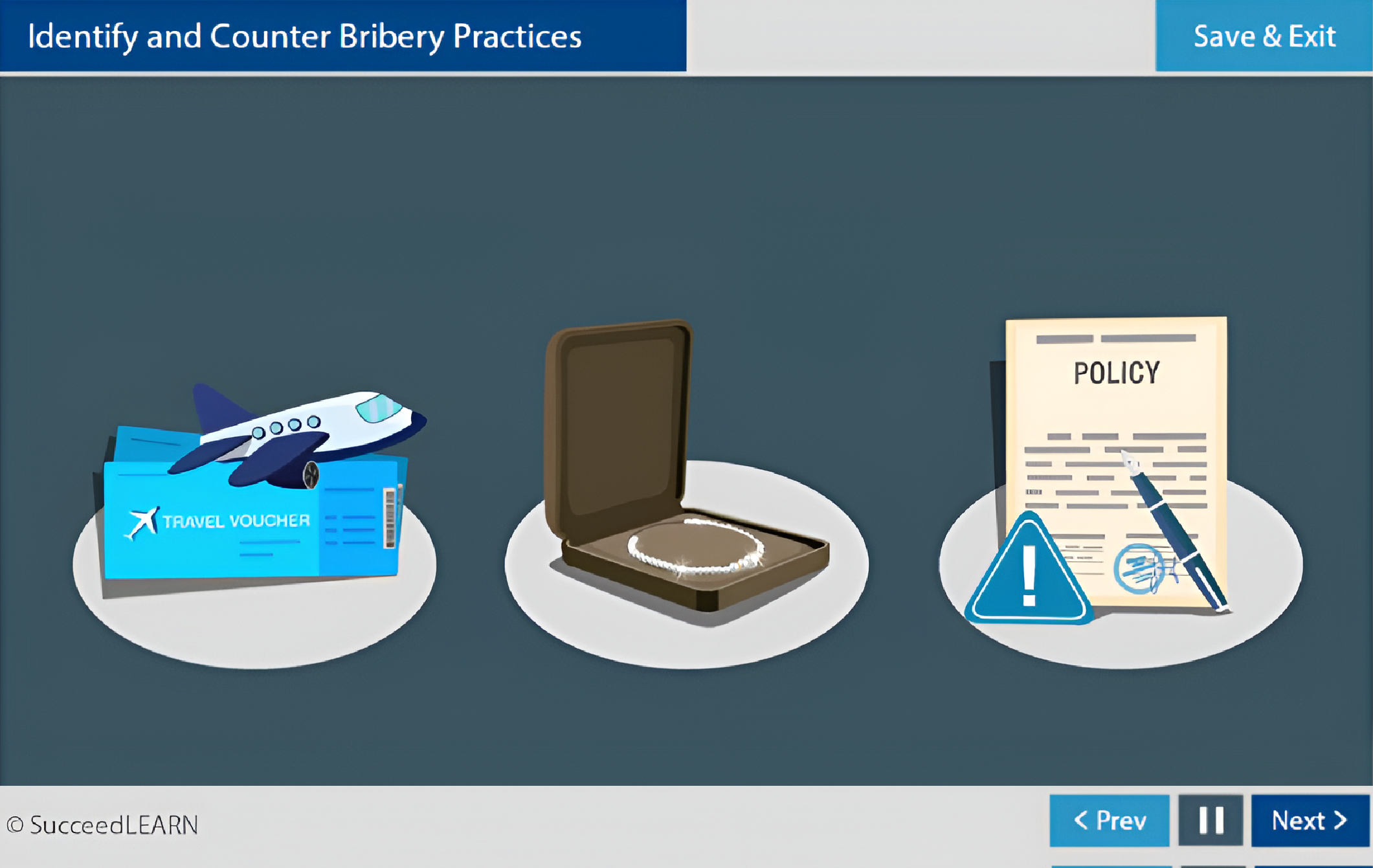
- Scenario-based activity on corporate hospitality and gifting
- Case-based examples of third-party, charitable, travel and promotional bribery risks
- A gamified journey following an employee on an international business trip, facing real-life bribery dilemmas at immigration, with vendors, agents and customs
- Knowledge checks and a final scenario-based assessment

Learning Objectives
By the end of this course, learners will be able to:
- Explain the concepts of corporate bribery and corruption and their impact on orgs
- Distinguish between permissible and prohibited corporate hospitality and business courtesies
- Understand and apply the org’s Anti-Bribery and Anti-Corruption (ABAC) Policy
- Identify common bribery and corruption practices in everyday business activities
- Respond appropriately to bribery risks by applying preventive controls, escalation, and reporting procedures
Why Anti-Bribery and Anti-Corruption eLearning Training?
Protects the org from severe reputational damage
The course highlights how bribery scandals can permanently tarnish an organisation’s brand, erode stakeholder trust, and leave a lasting “black mark” that impacts future business opportunities, partnerships, and market credibility.
Transforms abstract ethics into practical, defensible workplace behaviour
Through scenario-based learning (gifts, hospitality, travel, third-party interactions, charitable donations, facilitation requests), employees learn how to act in real situations - reducing the likelihood of “grey area” decisions that expose the employer to risk.
Strengthens internal controls through accurate documentation and transparency
The emphasis on proper record-keeping, approvals, receipts, and transparent expense reporting supports stronger internal audit trails, enabling employers to demonstrate responsible business practices during internal reviews or external scrutiny.
Minimises third-party and agent-related risk exposure
The training clearly explains how third parties are common conduits for corruption and reinforces the importance of due diligence, monitoring, and accountability - helping employers reduce indirect liability arising from vendors, agents, or intermediaries.
Prevents misuse of corporate hospitality and promotional spending
By clearly distinguishing reasonable business hospitality from excessive or inappropriate conduct, the course helps employers control discretionary spending while preventing hospitality from being misused as an influence tool.
Standardises responses during high-risk situations such as travel and cross-border engagements
Practical travel-related scenarios equip employees with consistent, org-approved responses when facing pressure abroad, reducing ad-hoc decisions that could expose the employer to reputational or operational fallout.
Scenario-driven learning built around real business dilemmas
The course uses realistic, workplace-relevant scenarios - covering gifts, hospitality, third parties, travel, donations, and facilitation requests - so employees practise making the right decisions in real situations, not just absorbing theory.
Laws & Regulations Addressed in Anti-Bribery training for employees
| Legislation / Concept | Relevance in the Course |
|---|---|
| UK Bribery Act 2010 | Core UK legislation on bribery in both public and private sectors, with extra-territorial reach and a specific corporate offence for failure to prevent bribery. |
| US Foreign Corrupt Practices Act (FCPA) | Major US law prohibiting improper payments to foreign public officials and requiring accurate books, records, and internal controls for organisations operating or listed in the US. |
| Prevention of Corruption Act (PCA) – Singapore | Primary Singapore anti-corruption statute criminalising giving and receiving “gratification” in public and private sectors, illustrating how local regimes complement global standards. |
| Dutch Criminal Code – Bribery Provisions | Dutch provisions covering active and passive bribery of domestic and foreign public officials and certain private-sector bribery, used to highlight fines and other sanctions for individuals and companies. |
| German Criminal Code – Bribery Provisions | German rules on bribery in business and bribery of public and elected officials, including certain acts committed abroad, emphasising personal criminal liability and potential imprisonment. |
| Prevention of Corruption Act 1988 – India | Indian legislation penalising giving and accepting bribes and other “gratification” involving public servants, showing how companies and individuals must manage interactions with officials in or connected to India. |
Course's Screenshots



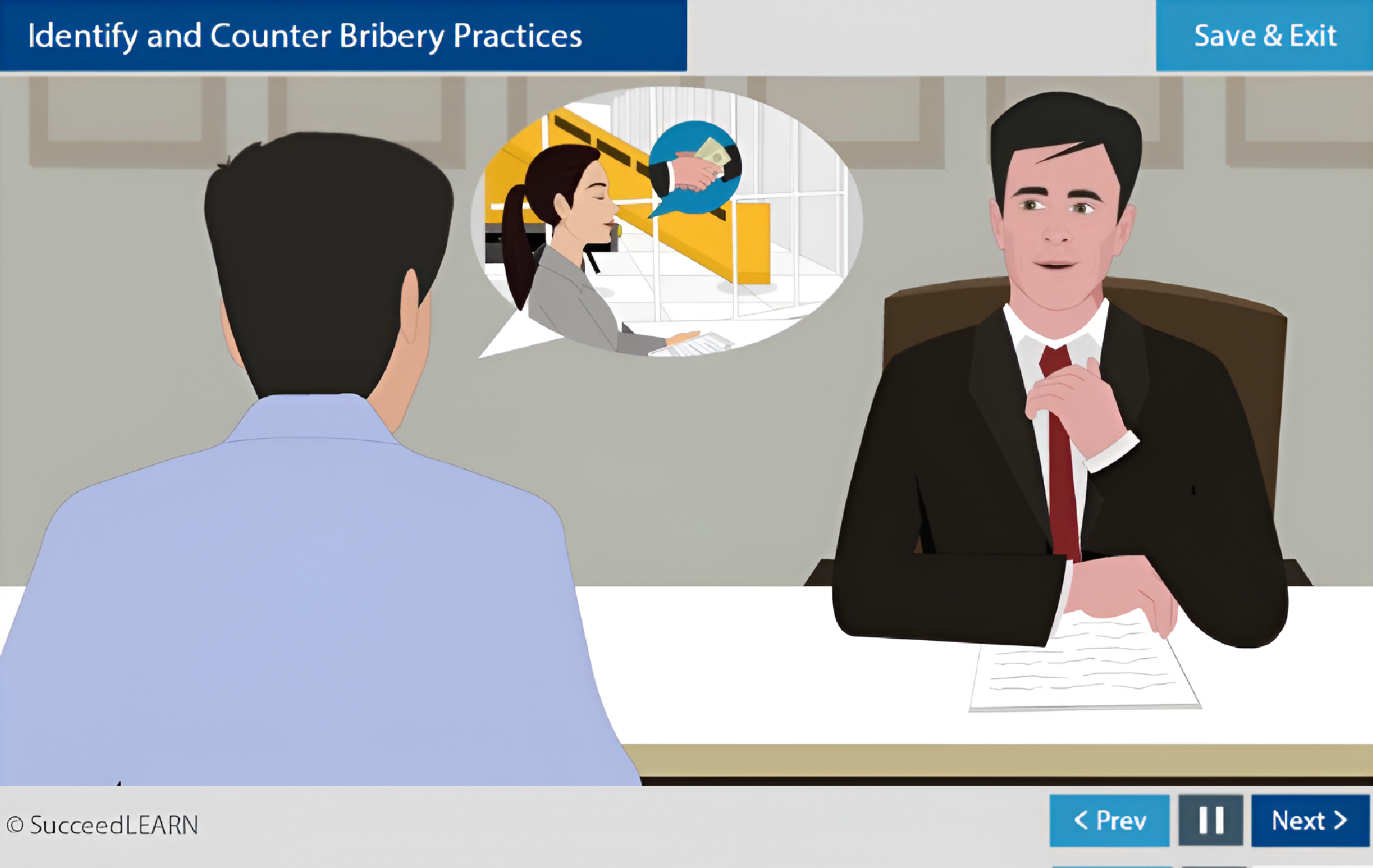


Course Structure
Learning elements
Format & accessibility
Designed for use across desktop, tablet, and mobile devices, the solution features a centralised learner dashboard, real-time progress tracking, automated learner reminders, and smooth integration with your existing LMS or HR systems.
Certificate
Upon successful completion, you receive a CPD certificate valid as proof of training.
Target Audience
This course is ideal for employees and managers across functions whose work may expose them or the organisation to bribery risk, especially those who:
- Interact with clients, suppliers, intermediaries, consultants or public officials
- Manage or approve gifts, hospitality, travel, entertainment or charitable donations
- Oversee third-party relationships, including agents, distributors or outsourcing partners
- Influence decisions on purchasing, procurement, sales, sponsorships or bids
- Work in compliance, legal, audit, finance, risk or corporate governance roles
In short, anyone who represents the org externally or can influence commercial decisions will benefit from this Anti Bribery Anti-corruption training.
Case Studies: Real Consequences of Non-Compliance
Implementing structured Anti Bribery Anti-corruption eLearning as part of your compliance programme is one of the most effective ways to demonstrate proactive risk management to regulators, clients and investors.
Below are real, enforcement cases that clearly demonstrate the consequences orgs have faced for failing to adhere to the Anti-Bribery & Anti-Corruption training:
- Siemens AG (Global): Siemens faced one of the largest corporate corruption penalties in history, paying approximately USD 1.6 billion after investigations revealed widespread bribery carried out through intermediaries to secure contracts across multiple countries. The case is frequently cited as a clear example of how the absence of robust anti-bribery training and controls can escalate into enterprise-wide failures with severe financial and reputational consequences for employers.
- Airbus SE (Europe / Global): Airbus agreed to a global settlement of approximately USD 4 billion after investigations found that improper payments were made through intermediaries to influence aircraft sales across several countries. The case highlights how inadequate oversight of third parties, poor documentation, and weak internal awareness can expose orgs to significant financial penalties and long-term reputational damage.
Course Outline
Introduction to Corporate Bribery and Corruption
Global Anti-Bribery and Anti-Corruption Laws
Anti-Bribery Policy and Corporate Hospitality
Forms of Bribery in Everyday Business
Identifying, Resisting and Reporting Bribery
Gamified Scenario: Janet’s Business Trip
See how Succeed will work for your Organization

Request a Demo
FAQs
Bribery is offering, giving, receiving, or soliciting anything of value to influence a decision or gain an improper advantage.
This can include cash, gifts, hospitality, favors, contracts, or job offers.
Corruption is the abuse of entrusted power for private gain.
It includes bribery as well as other misconduct such as kickbacks, facilitation payments, fraud, and conflicts of interest.
ABAC refers to laws, policies, and practices designed to prevent bribery and corrupt conduct in business and public dealings.
This training helps employees recognise, prevent, and respond appropriately to bribery and corruption risks that commonly arise in everyday business activities such as gifting, hospitality, travel, vendor engagement, and third-party interactions, thereby protecting the organisation’s reputation and operations.
The training is relevant for all employees, with particular importance for those involved in procurement, sales, vendor management, finance approvals, third-party oversight, business travel, and senior decision-making roles.
No. The course clearly explains that bribery can take many forms beyond cash, including extravagant gifts, leisure trips, excessive hospitality, disguised promotional expenses, charitable donations, and improper advantages offered through intermediaries.
The programme uses realistic, scenario-based activities that mirror workplace situations, enabling employees to practise identifying acceptable versus inappropriate conduct and reinforcing correct decision-making through immediate feedback.
The course explains how third parties, agents, and intermediaries can expose the org to risk and reinforces the need for due diligence, transparency, monitoring of services, and accountability when working with external representatives.
Employees learn how to distinguish reasonable business hospitality from inappropriate or excessive conduct, with clear guidance on acceptable thresholds, documentation, approvals, and situations where gifts or entertainment must be declined.
The training emphasises accurate record-keeping, proper approvals, receipt submission, and clear documentation of business purpose, helping organisations strengthen internal controls and maintain audit-ready expense processes.
Yes. Employees are guided through realistic travel-related scenarios where they may face pressure from officials, agents, or vendors, helping them respond consistently and ethically while protecting the org.
The course clearly encourages employees to report suspected misconduct or concerns promptly through internal escalation channels, reinforcing a speak-up culture and early risk identification.
By combining awareness, practical scenarios, assessments, and an integrity pledge, the training reinforces accountability at an individual level and supports a consistent, organisation-wide commitment to ethical business conduct.
Yes. Learners must complete a final assessment to demonstrate understanding of key concepts, ensuring that employees actively engage with the content rather than passively completing the course. Successful completion can be tracked via the LMS and used as evidence of ABAC training for audits or regulatory reviews.
Beyond risk prevention, the training helps orgs protect brand reputation, promote fair competition, reduce operational disruptions, and demonstrate a proactive commitment to ethical and responsible business practices.
The delivery is fully flexible. If you have an in-house LMS, we can provide the course as a SCORM-compliant package. If not, we offer a seamless SaaS-based hosting option for easy access and deployment.