Skip to content
S-Phish

Phishing Simulation Tool

Enterprise Phishing Simulation Tool for Building a Stronger Human Firewall

Email continues to be one of the most exploited attack vectors, with phishing remaining the leading cause of credential theft, ransomware, and business email compromise. While technical security controls block thousands of malicious emails every day, it only takes one successful click to create a costly security incident.

S-Phish is SucceedLEARN's enterprise phishing simulation platform, designed to transform phishing awareness from theoretical knowledge into practical experience through realistic simulations, behaviour-based learning interventions and actionable analytics.

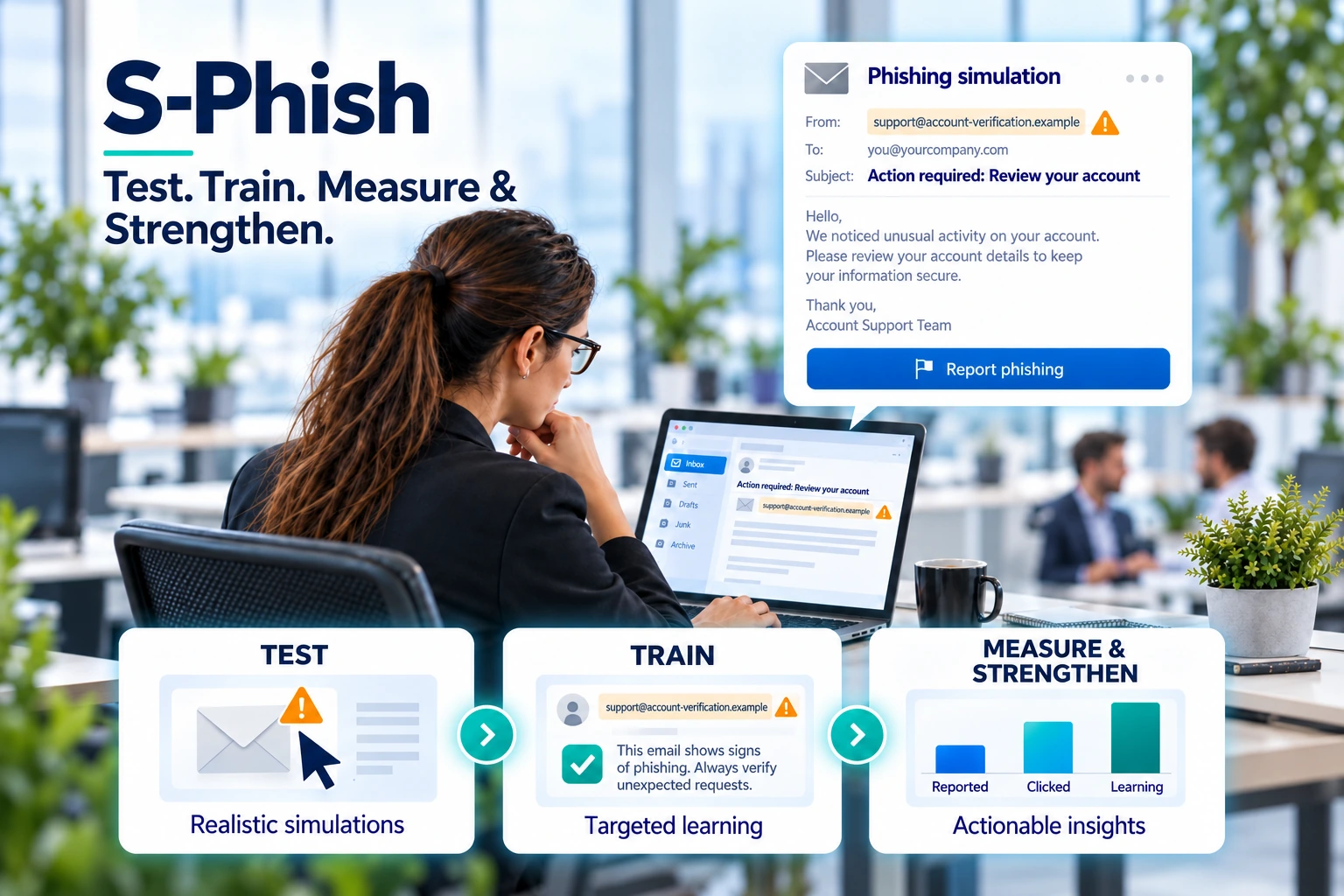
Test | Train | Measure & Strengthen

S-Phish phishing simulation tool: Test, Train, Measure & Strengthen
Why Phishing Simulation Matters

Phishing Has Evolved. Has Your Phishing Simulation Kept Up?

Modern phishing attacks are no longer limited to poorly written emails with suspicious links. Attackers now leverage AI-generated content, QR code phishing, credential harvesting pages, malicious attachments, and highly personalised social engineering tactics to deceive even experienced employees.

Although organisations continue investing heavily in firewalls, endpoint protection, and email security solutions, the human element remains one of the most targeted attack surfaces. Security awareness training builds knowledge, but organisations also need a practical way to measure whether employees can recognise and respond correctly when confronted with real phishing attempts.

Security awareness training helps employees understand phishing.

Phishing simulation helps organisations understand whether employees can apply that knowledge in practice.

S-Phish safely puts employees' awareness to the test through controlled simulations, giving organisations visibility into behaviour while creating opportunities for targeted learning and improvement.

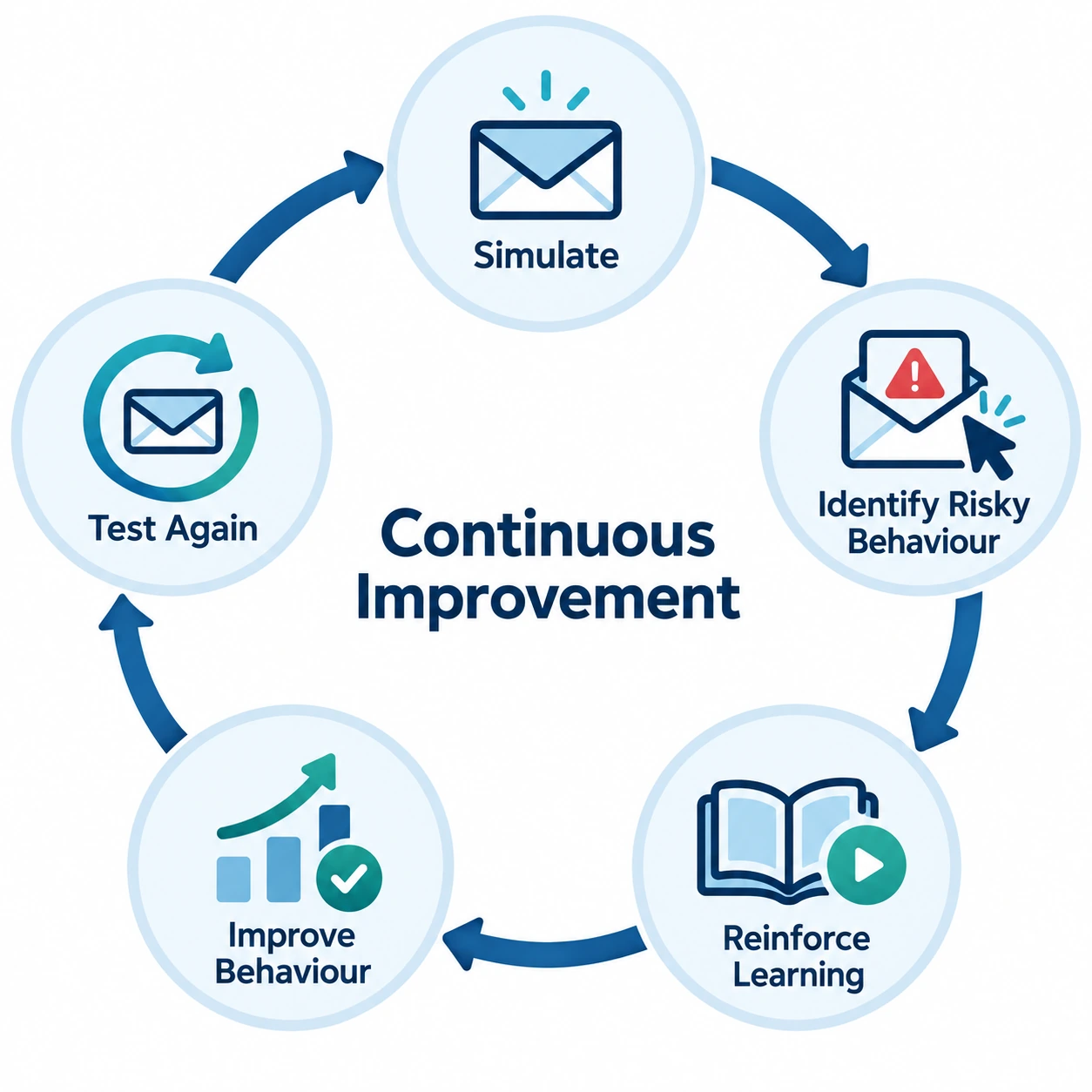
S-Phish continuous improvement cycle: Simulate, Identify Risky Behaviour, Reinforce Learning, Improve Behaviour, Test Again
Learning Opportunities

Transform Phishing Failures into Learning Opportunities

Test Employees. Then Help Them Improve

The purpose of phishing simulation isn't simply to identify mistakes, but to help employees make safer decisions when a genuine threat appears.

S-Phish turns risky interactions into immediate learning opportunities by automatically enrolling employees who interact with simulated phishing emails into targeted remedial training. This allows organisations to address knowledge gaps and reinforce secure behaviours while the simulated experience is still fresh, rather than waiting for the next scheduled awareness course.

Over repeated campaigns, this creates a continuous feedback loop:

Simulate → Identify Risky Behaviour → Reinforce Learning → Improve Behaviour → Test Again

By connecting phishing simulations with targeted learning, S-Phish transforms campaign results from a measure of failure into an opportunity for continuous, measurable behavioural improvement.

Meet S-Phish

Meet S-Phish: SucceedLEARN's Phishing Simulation Tool

Turn Phishing Awareness into Practical Readiness

S-Phish is a comprehensive phishing simulation platform designed to help organisations assess, strengthen and continuously monitor employee resilience against phishing and social engineering threats.

Administrators can create and manage realistic phishing campaigns, select relevant attack scenarios, target different employee populations, control campaign schedules and analyse employee responses through detailed reporting.

But S-Phish isn't designed simply to identify who clicked.

When risky behaviour occurs, simulation outcomes can become learning opportunities. Targeted remedial awareness training helps employees understand what they missed and reinforces safer responses while the experience is still relevant.

Rather than treating phishing simulation as a one-off test, organisations can use S-Phish as part of an ongoing programme for understanding and strengthening human cyber resilience.

How S-Phish Works

How SucceedLEARN's Phishing Simulation Tool works

Launch a Phishing Simulation in Five Structured Steps

S-Phish provides administrators with a guided campaign creation process that makes simulations configurable while keeping campaign management straightforward.

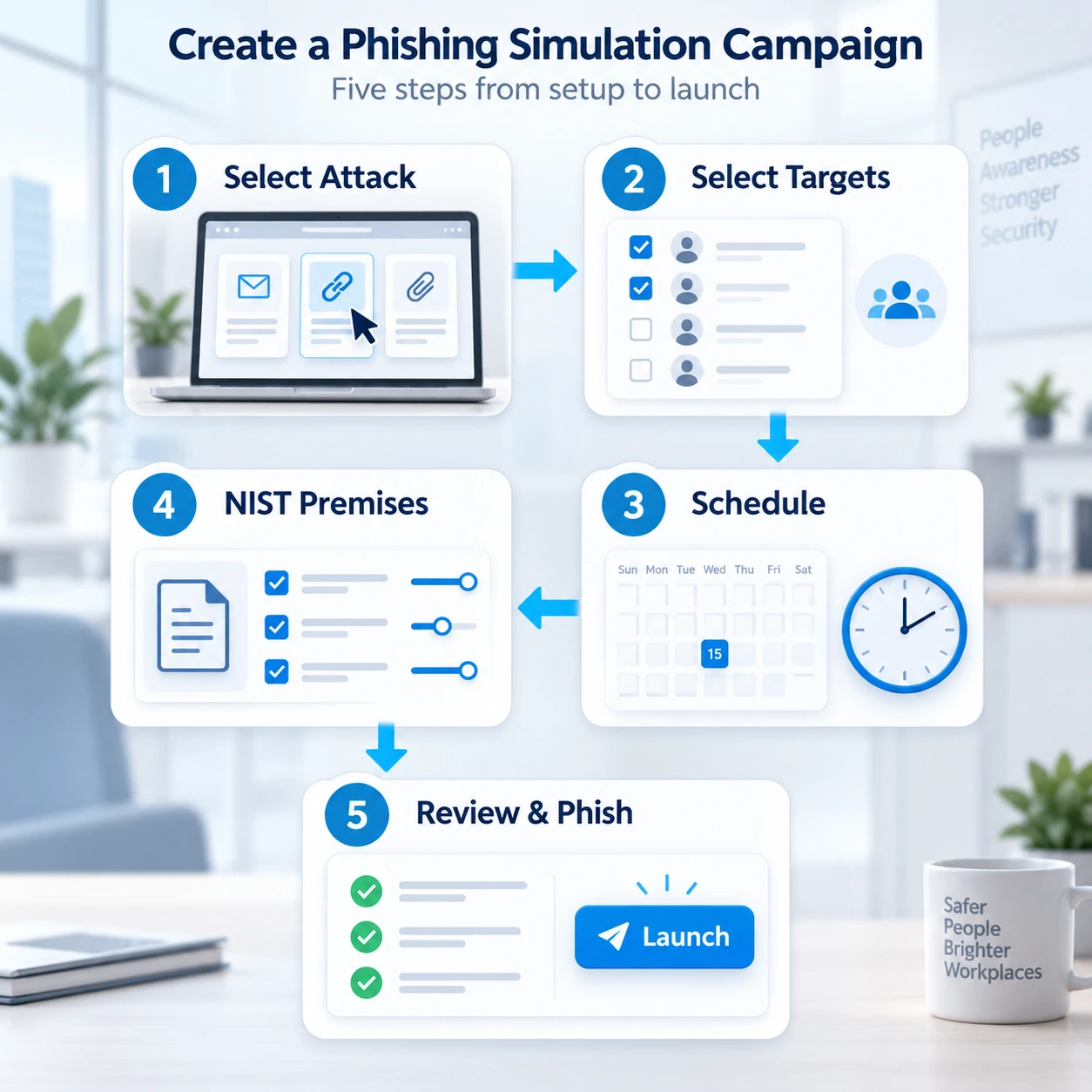
Create a phishing simulation campaign in five steps

Select Attack

Choose from a comprehensive library of phishing attack scenarios. Administrators can select professionally designed phishing templates or combine multiple templates within a single campaign to closely replicate real-world attack patterns.

Select Targets

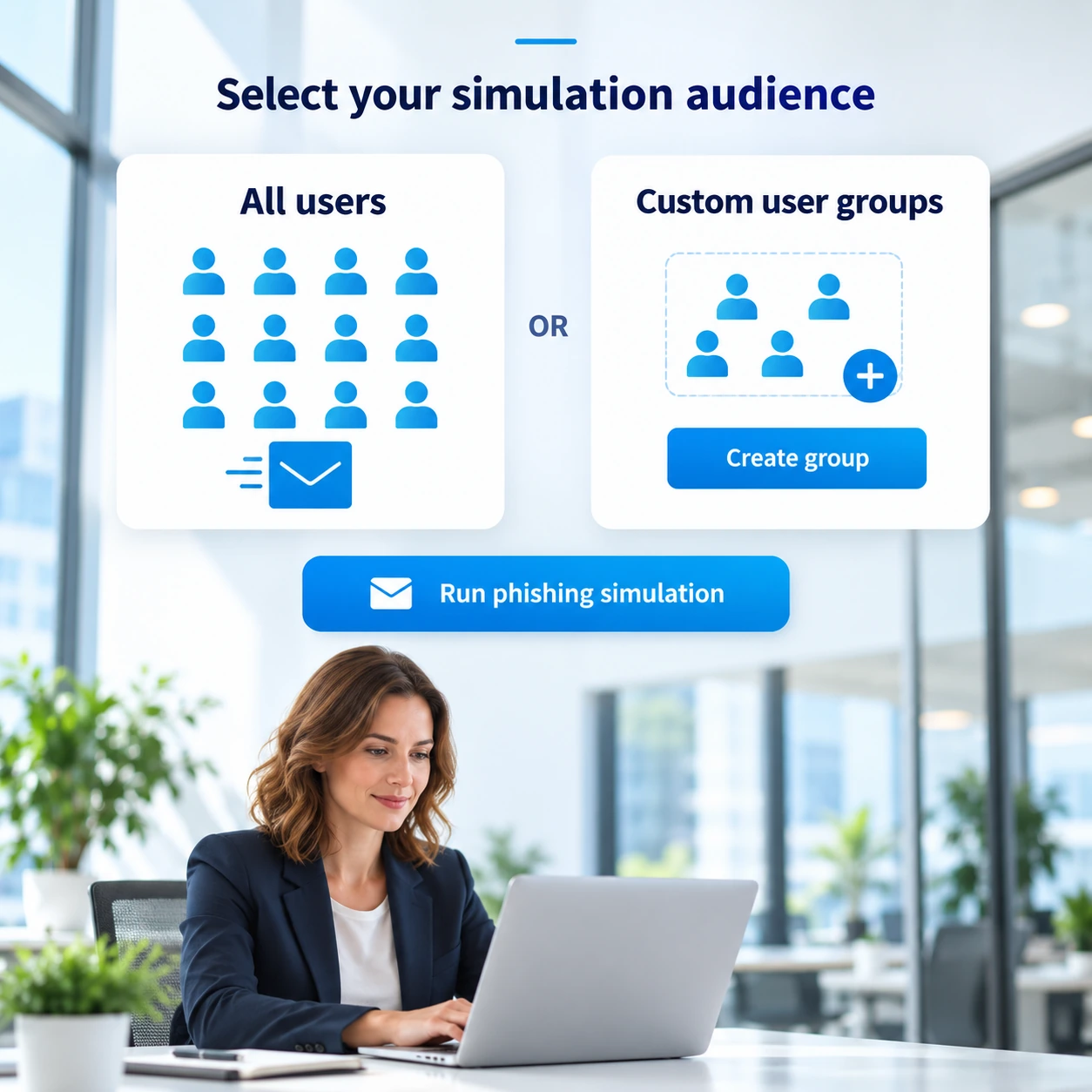
Campaigns can be deployed organisation-wide or customised for specific groups based on teams, location, custom user groups etc. This flexibility enables organisations to assess different user populations based on their security risk profile.

Schedule

S-Phish provides flexible campaign scheduling options to align with your security awareness strategy.

Flexible scheduling allows administrators to control campaign delivery rather than sending every simulation to every participant at exactly the same moment.

Campaign timing can be structured to create a more natural experience and better reflect the unpredictability of real phishing attacks.

NIST Premises - Optional

As an optional step, phishing campaigns can be mapped to the NIST Cybersecurity Framework to support broader governance and compliance initiatives.

This helps organisations strengthen their security awareness programmes while demonstrating alignment with globally recognised cybersecurity best practices.

Review & Phish

Before deployment, administrators can review every campaign setting. Once reviewed, campaigns can be launched with a single click, allowing organisations to immediately begin assessing employee behaviour through realistic phishing simulations.

Flexible Campaign Targeting

Target the Right Employees with the Right Simulation

Not every employee encounters cyber risk in exactly the same way.

S-Phish gives administrators flexibility to conduct broader organisation-wide campaigns as well as more focused simulations for selected employee groups.

Campaigns can therefore be structured around different organisational populations and awareness objectives rather than relying exclusively on identical simulations for the entire workforce.

  • Organisation-Wide Campaigns
  • Department or Team Campaigns
  • Location-Based Campaigns
  • Higher-Risk Populations
Target the right employees with the right phishing simulation
Reporting & Behavioural Analytics

Measure More Than Campaign Completion

Powerful Reporting & Behavioural Analytics

A phishing campaign creates valuable behavioural data. S-Phish turns that data into visibility that security teams can use to understand campaign performance, identify potential areas of human risk and monitor changes over time.

Campaign reports include:

  • Resiliency Score
  • Campaign Performance
  • Email Delivery Status
  • Email Opens
  • Link Clicks
  • Reporting Behaviour
  • Training Completion Status
  • Department-wise Performance
  • User-wise Risk Analysis

For broader organisational insights, S-Phish seamlessly integrates with S-Metrics, providing enterprise dashboards that consolidate organisation-wide phishing campaign performance, behavioural trends, and workforce security maturity into a single reporting interface.

Reports can also be exported or printed to support management reporting, compliance audits, and continuous programme improvement.

Platform Security

How Secure is S-Phish?

Privacy by Design

S-Phish is designed with privacy in mind. Data processed through the platform is protected using appropriate security controls, and S-Phish does not read or inspect users' mailbox contents as part of normal phishing simulation activities.

Encryption in Transit & at Rest

Customer data is protected using encryption both in transit and at rest. Communications with the platform are secured using TLS 1.2 or higher, while stored data is protected using encryption-at-rest mechanisms.

Security & Privacy Compliance

SucceedLEARN follows established security and privacy practices and maintains applicable certifications and attestations, including ISO 27001 and SOC 2 (Compliance frameworks followed by Succeed Technologies Private Limited).

Secure Authentication & Access Control

S-Phish supports secure authentication mechanisms, including Single Sign-On (SSO) and OAuth-based authentication, allowing organisations to integrate with their existing identity and authentication environments.

Role-Based Access Control (RBAC)

Role-Based Access Control ensures that users and administrators can access only the functionality and information permitted for their assigned roles, supporting the principle of least privilege.

Audit Logging & Security Monitoring

Security-relevant activities and administrative actions are logged to support monitoring, troubleshooting, security investigations and compliance requirements. Security monitoring mechanisms help identify and respond to potentially suspicious activity.

API Security

S-Phish incorporates security controls for API-based connectivity to help protect communication and data exchange between the platform and connected enterprise systems.

Vulnerability Management & Penetration Testing

S-Phish undergoes security testing practices including vulnerability scanning and penetration testing to help identify and address potential security weaknesses.

Data Retention

S-Phish follows defined data-retention practices to ensure information is retained only in accordance with applicable organisational, contractual and security requirements.

PhishCue (Available for organisations using Microsoft Outlook).

When an Employee Spots a Suspicious Email, What Happens Next?

Recognising a suspicious email is only the first step. Employees need a simple way to report it, while security teams need the visibility to investigate what has been reported and take appropriate action.

PhishCue connects the two.

Designed for organisations using Microsoft Outlook, PhishCue enables employees to report suspicious emails through Outlook's default Report button. From there, the reported email is captured for analysis, giving security teams visibility into the message while supporting the appropriate reporting of phishing emails to Microsoft.

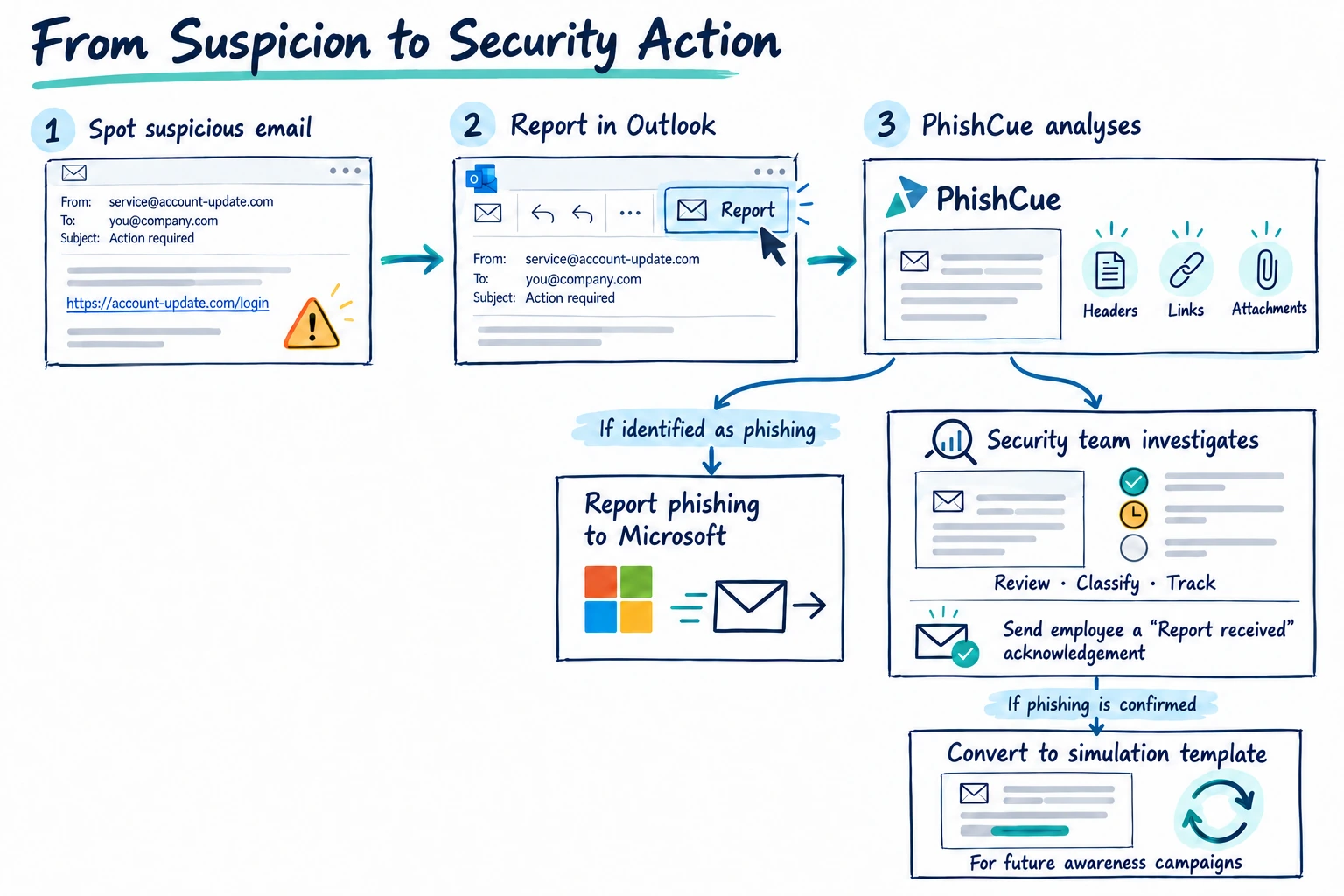
PhishCue reporting workflow from suspicion to security action

From Suspicion to Security Action

  • Employee Spots a Suspicious Email Something about an email doesn't feel right. It could be an unexpected request, an unfamiliar link, an unusual attachment or a message that simply seems out of context.
  • Reports It Directly From Outlook Instead of ignoring, deleting or manually forwarding the email, the employee uses Outlook's default Report button to flag the suspicious message.
  • PhishCue Captures & Analyses the Report The reported email is centrally captured by PhishCue. Relevant message information, including email headers, links and attachments, is analysed to help determine whether the message is legitimate, spam or a potential phishing threat.
  • Phishing Emails Are Reported to Microsoft When the reported message is identified as phishing, the relevant report is also submitted to Microsoft, supporting Microsoft's visibility into reported phishing threats. Importantly, reporting the email to Microsoft does not remove it from the organisation's security workflow.
  • Your Security Team Can Investigate It Too The reported email remains available to the organisation's security team through the PhishCue dashboard. Security teams can review the message and its analysis, investigate the reported threat, classify it and track its status, giving them visibility into the suspicious emails employees are encountering. Employees can also receive an automated confirmation acknowledging that their report has been received.
  • Confirmed Phishing Becomes Future Awareness A confirmed phishing email can be converted into a phishing simulation template for future employee awareness campaigns. This means a real phishing attempt encountered by one employee can become a relevant learning opportunity for the wider workforce.

Spot. Report. Investigate. Reinforce. Employee spots a suspicious email → Reports it through Outlook → PhishCue analyses it → Phishing is reported to Microsoft → Security team investigates and tracks it → Confirmed threats can become future simulations

Turn Employee Reporting Into Actionable Security Insight

PhishCue helps bridge the gap between employee reporting and security-team investigation. Employees get a familiar way to report suspicious emails, Microsoft receives relevant phishing reports, and internal security teams retain the visibility needed to investigate reported threats and use those insights to strengthen future awareness.

Why Choose S-Phish

Why Organisations Choose SucceedLEARN's Phishing Simulation Tool

S-Phish is designed to support organisations seeking to strengthen employee resilience against phishing attacks while improving visibility into human cyber risk.

Key capabilities include:

Realistic Phishing Simulations

Test employees using realistic phishing templates designed to reflect the types of deceptive communications they may encounter in their everyday digital environment.

Configurable

Select attack scenarios, define target populations, manage scheduling and review campaign settings through a structured workflow.

Behaviour-Focused

Measure what employees actually do when they encounter a simulated threat rather than relying solely on awareness completion.

Educational

Turn risky interactions into opportunities for targeted remedial learning and immediate reinforcement.

Measurable

Monitor opens, clicks, reporting, information submission, training completion and other campaign indicators through detailed reporting.

Actionable

Use campaign results to identify where additional awareness, reinforcement or testing may be required.

Security Culture & Collaboration

Designed for the Teams Driving Security Culture

Building employee resilience against phishing often requires collaboration between cybersecurity, compliance, learning and people functions.

S-Phish provides the behavioural visibility and learning interventions these teams need to contribute to a more resilient workforce.

Information Security & Cybersecurity Teams

Create and manage phishing simulations, assess employee behaviour, identify potential areas of human cyber risk and monitor phishing resilience over time.

Compliance & Risk Teams

Use structured campaign activity and reporting to support security awareness governance, programme reviews and relevant compliance initiatives.

Learning & Development Teams

Connect simulation outcomes with targeted learning interventions that help employees strengthen their understanding after risky behaviour occurs.

HR & People Teams

Support organisation-wide security culture initiatives and help employees understand their role in recognising and reporting suspicious communications.

Leadership

Gain greater visibility into organisational phishing resilience, behavioural trends and areas where continued awareness investment may be required.

Security Behaviour & Culture Suite

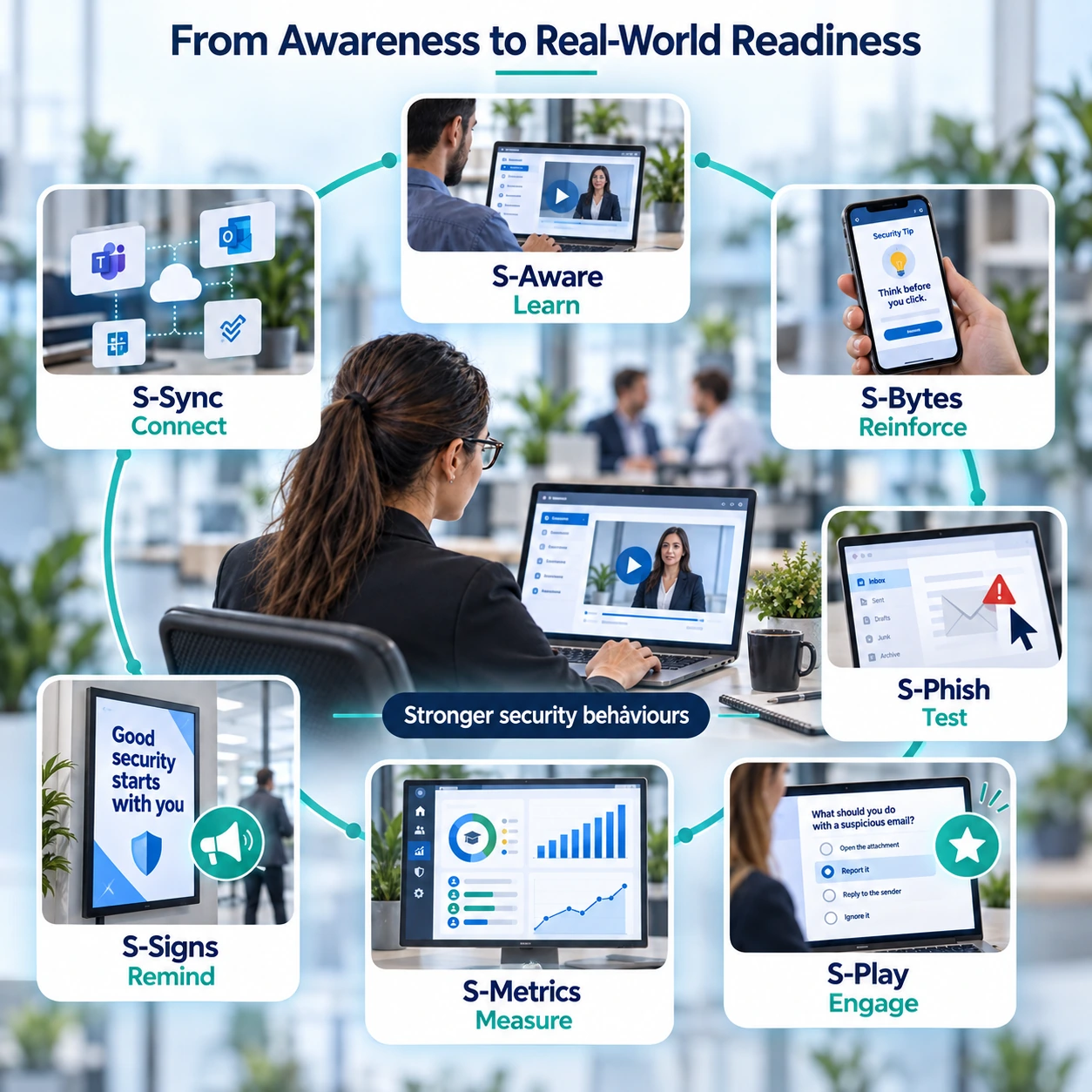
From Awareness to Real-World Readiness

As part of the SucceedLEARN Security Behaviour & Culture Suite, continuous learning, reinforcement, engagement, testing and measurement work together to help organisations build stronger security behaviours.

From Awareness to Real-World Readiness

S-Aware

Learn

Build foundational cybersecurity and privacy knowledge.

S-Bytes

Reinforce

Keep important security concepts fresh through continuous microlearning.

S-Phish

Test

Give employees practical experience recognising realistic phishing threats.

S-Play

Engage

Reinforce cybersecurity concepts through interactive and gamified learning.

S-Signs

Remind

Keep security visible through ongoing awareness campaigns and visual nudges.

S-Metrics

Measure

Bring awareness and behavioural data together to understand programme performance.

S-Sync

Connect

Integrate security awareness with the organisation's wider learning and technology ecosystem.

Together, these solutions create a continuous cycle of learning, testing, reinforcement and measurement.

Traditional Phishing Awareness vs S-Phish

Traditional Phishing Awareness vs SucceedLEARN's Phishing Simulation Tool

Standard Phishing Simulation S-Phish
Primarily tests whether employees click a simulated phishing email Tests multiple employee behaviours across controlled phishing simulations
Often relies on a standard phishing template for a campaign Supports realistic attack scenarios and flexible campaign configuration
Campaigns are typically sent to selected employees or groups Supports organisation-wide, group, department and targeted employee simulations
Primarily identifies who interacted with the simulation Captures multiple behavioural indicators across the phishing journey
Clicks or failures are commonly the main campaign outcome Measures delivery, opens, clicks, reporting behaviour and other campaign indicators
Failed simulations may simply be recorded for reporting Risky behaviour can trigger relevant remedial learning
Reporting is largely focused on individual campaign results Provides campaign, group and user-level visibility to identify patterns and areas requiring reinforcement
Simulation activity can remain separate from employee awareness training Connects phishing testing with the wider SBCS awareness ecosystem for learning, reinforcement and measurement
Each campaign provides a point-in-time view of employee response Supports an ongoing cycle of Simulate → Observe → Educate → Measure → Improve
Frequently Asked Questions

Frequently Asked Questions

What is S-Phish?

S-Phish is SucceedLEARN's enterprise phishing simulation tool designed to help organisations assess how employees respond to simulated phishing threats. It enables administrators to create campaigns, select phishing templates, target employee groups, schedule simulations, monitor employee behaviour, assign remedial learning if required and analyse campaign performance through detailed reporting.

What is phishing simulation?

Phishing simulation is a controlled cybersecurity awareness exercise in which employees receive simulated phishing communications designed to resemble real-world threats. The objective is to safely evaluate how employees recognise and respond to suspicious communication while identifying opportunities for additional awareness and reinforcement.

Why should organisations conduct phishing simulations?

Security awareness training helps employees understand phishing, but simulation provides a practical way to assess how that knowledge is applied. Regular simulations can help organisations identify risky behaviours, measure employee reporting behaviour, reinforce learning and understand how phishing resilience develops over time.

Can phishing simulations be targeted to specific employee groups?

Yes. S-Phish allows campaigns to be directed towards selected employee populations rather than requiring every simulation to be sent organisation-wide. Depending on organisational configuration, campaigns can be structured around groups such as teams, locations and business units.

Can S-Phish campaigns be scheduled?

Yes. S-Phish provides campaign scheduling capabilities that enable administrators to control how and when simulated phishing communications are delivered. This helps organisations conduct simulations in a more structured and less predictable manner.

What does S-Phish measure?

Depending on the campaign, reporting can include indicators such as email delivery, email opens, link clicks, information submission, reporting behaviour, user-level analysis and the S-Phish Resiliency Score. These metrics provide organisations with greater visibility into how employees respond to simulated threats.

Does S-Phish provide individual and organisation-wide reporting?

Yes. S-Phish provides reporting that can support both organisation-level and user-level analysis. This enables administrators to understand broader workforce patterns while also identifying areas where more targeted reinforcement may be appropriate.

How does S-Phish work with S-Metrics?

S-Phish provides detailed phishing campaign and behavioural data. Within the wider SucceedLEARN Security Behaviour & Culture Suite, S-Metrics can bring phishing-related insights together with other awareness and engagement information to provide a broader view of programme performance and workforce security behaviour.

How does S-Phish fit into the SucceedLEARN Security Behaviour & Culture Suite?

S-Phish provides the testing and practical simulation layer of SBCS. S-Aware builds foundational knowledge, S-Bytes reinforces concepts through microlearning, S-Phish tests employees against simulated threats, S-Play provides gamified reinforcement, S-Signs maintains visual awareness, S-Metrics supports measurement and S-Sync connects the wider ecosystem. Together, the solutions help organisations move from periodic awareness activities towards continuous security behaviour development.

Get Started

Request a personalised demo and discover S-Phish

S-Phish helps organisations continuously assess employee readiness, strengthen phishing awareness through realistic simulations, reinforce secure behaviours through targeted learning, and measure progress with enterprise-grade reporting.

Whether your objective is reducing phishing susceptibility, strengthening compliance initiatives, or building a resilient security culture, discover how S-Phish can help your organisation Test. Learn. Strengthen.

Request a Demo

This site is protected by reCAPTCHA.