Skip to content
Home / OWASP Top 10
OWASP Top 10:2025 · Secure Application Development

OWASP Top 10:2025 Training for Developers

Help your development teams understand the application-security risks that matter most: how common weaknesses occur, how they may be exploited, and the practical development practices that can reduce risk.

Move beyond simply knowing vulnerability names. Build the security mindset required to recognise weaknesses earlier and make more secure decisions throughout the software development lifecycle.

  • OWASP Top 10:2025 coverage
  • Built for developers & technical teams
  • Practical scenarios & knowledge checks
  • Secure Coding & Secure SDLC principles
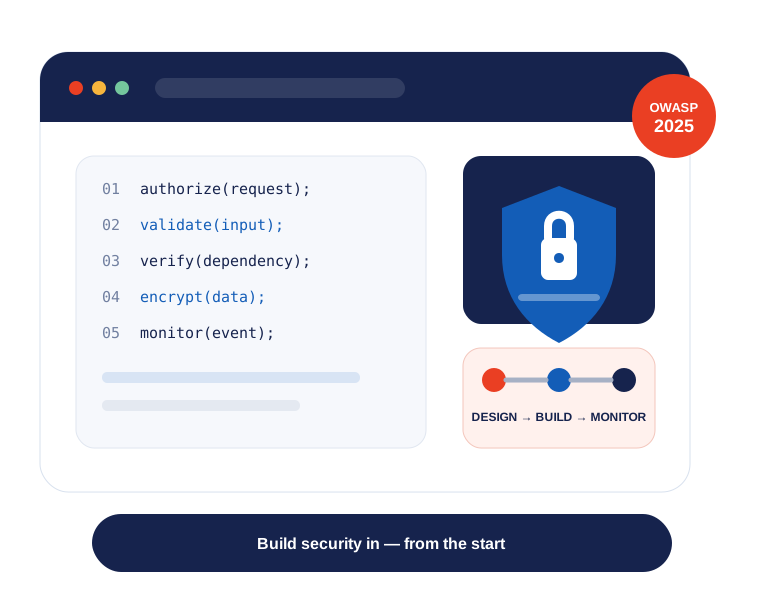
Illustration of secure application development and OWASP Top 10 risk awareness
Course overview

Application Security Starts Before the Security Test

Modern applications depend on APIs, cloud services, open-source libraries, third-party components and automated development pipelines. That speed and connectivity create enormous opportunities — but they also introduce security risks at every stage of software development.

A vulnerability may originate from a missing permission check, unsafe configuration, vulnerable third-party software, weak cryptographic implementation, improperly handled user input, insecure application design, weak authentication, unverified software or data, insufficient logging and alerting, or an application that responds unsafely when something goes wrong.

The OWASP Top 10:2025 provides a widely recognised framework for understanding these application-security risks. SucceedLEARN turns those concepts into practical eLearning that helps technical teams understand not only what can go wrong, but also why it happens and how development decisions can reduce the risk.

A direct answer for learners and buyers

What Is the OWASP Top 10?

The OWASP Top 10 is a widely recognised application-security awareness resource developed by the Open Worldwide Application Security Project. It identifies ten major categories of security risk affecting modern web applications and gives developers, security teams and technology organisations a shared language for discussing application-security weaknesses.

The OWASP Top 10:2025 reflects changes in modern development environments, including cloud infrastructure, software supply chains, automated delivery pipelines and emerging application-security risks. This training translates those concepts into practical learning for people responsible for building and maintaining software.

Course content

Explore the OWASP Top 10:2025

Ten core application-security risk categories, explained through practical developer-focused learning.

A01

Broken Access Control

Understand what happens when applications fail to correctly enforce who is allowed to access what. Learners explore authentication versus authorisation, least privilege, server-side permission checks, IDOR, request manipulation, forced browsing and access-control models.

Key takeaway: Being authenticated does not automatically mean a user is authorised to access every resource or perform every action.

A02

Security Misconfiguration

Even securely written applications can become vulnerable when systems, services or environments are incorrectly configured. Explore insecure defaults, unnecessary services, exposed administrative functionality, directory listing, verbose production errors, cloud configuration, excessive permissions, security headers and configuration hardening.

Key takeaway: Application security depends on secure configuration as well as secure code.

A03

Software Supply Chain Failures

Modern applications rely heavily on third-party libraries, packages, frameworks, repositories and automated development processes. Learners explore direct and transitive dependencies, outdated or vulnerable components, malicious packages, compromised software updates, dependency visibility, SBOM, Software Composition Analysis, trusted software sources, patching and supply-chain risk reduction.

Key takeaway: Know what enters your software and manage the trust you place in external components and development systems.

A04

Cryptographic Failures

Sensitive information needs protection throughout its lifecycle. This module explores sensitive-data classification, password protection, hashing versus encryption, salting, encryption at rest, encryption in transit, TLS, HSTS, cryptographic key protection and data minimisation.

Key takeaway: Encryption alone is not enough. Cryptography must be selected, implemented and managed correctly.

A05

Injection

Injection occurs when applications fail to keep untrusted data separate from executable instructions. Learners explore SQL, NoSQL, OS Command, LDAP, XPath, header-related injection, Cross-Site Scripting and other interpreter-based attacks. Preventive concepts include parameterised queries, safe APIs, allow-list validation, secure input handling, contextual output encoding and separation of data from executable commands.

Key takeaway: Treat untrusted input as data — never as executable instructions.

A06

Insecure Design

Some vulnerabilities begin before the first line of code is written. Learners explore how insecure architecture, workflows and business logic can create security weaknesses even when the software behaves exactly as designed. Topics include Secure SDLC, shift-left security, threat modelling, misuse and abuse cases, secure design principles, business-logic risks and resource abuse.

Key takeaway: Security cannot always be patched into an application later. It must be considered during requirements and design.

A07

Authentication Failures

Authentication answers a fundamental security question: “Is this user really who they claim to be?” Learners explore credential stuffing, brute-force attacks, weak or compromised passwords, phishing, multi-factor authentication, secure login behaviour, session management, secure session identifiers, logout and session invalidation, and trusted authentication frameworks.

Key takeaway: Strong authentication requires secure credentials, secure login processes and secure session management.

A08

Software or Data Integrity Failures

Applications frequently receive software, updates, files, build artifacts and data from systems they do not fully control. Learners explore trust boundaries, software authenticity, cryptographic hashes, digital signatures, certificate validation, CI/CD artifact verification, trusted repositories, integrity validation and insecure deserialisation.

Key takeaway: Verify before trusting or executing software and data.

A09

Security Logging and Alerting Failures

Security events cannot be investigated or stopped effectively if nobody knows they are happening. Learners explore what should be logged, how logs should be protected, what should never appear in logs, how suspicious activity is detected, why alert fatigue matters, and why alerts need defined ownership and response playbooks.

Log Protect Monitor Alert Respond

Key takeaway: Logging is only useful when it leads to meaningful detection, alerting and response.

A10

Mishandling of Exceptional Conditions

Applications will eventually encounter errors, timeouts, failed transactions and unexpected inputs. Learners explore fail-safe and fail-closed behaviour, transaction rollback, safe error messages, centralised exception handling, monitoring repeated errors, rate limiting, resource controls, input validation and maintaining safe system states during failures.

Key takeaway: Applications should remain secure and predictable even when something goes wrong.

More than the Top 10

Build the Secure Coding Mindset

The program also introduces foundational secure-development concepts that connect the individual OWASP risks. Secure coding is not simply about memorising rules. It is about helping developers make small, deliberate and security-aware decisions during everyday development.

  • Secure Software Development Life Cycle
  • Shift-left security
  • CIA Triad
  • Minimising attack surface
  • Secure defaults
  • Principle of least privilege
  • Defence in depth
  • Failing securely
  • Separation of duties
  • Avoiding security through obscurity
  • Managing third-party dependencies
  • Fixing vulnerabilities at the root cause
Learning outcomes

What Will Learners Be Able to Do?

Build practical awareness that supports more secure decisions across design, development, testing and deployment.

01

Recognise common application-security weaknesses.

02

Understand how normal application functionality can be misused or attacked.

03

Distinguish authentication from authorisation.

04

Identify differences between design, implementation and configuration weaknesses.

05

Understand common software supply-chain risks.

06

Apply secure input-handling and injection-prevention principles.

07

Understand appropriate protection of sensitive information.

08

Recognise insecure authentication and session-management practices.

09

Understand software and data integrity verification.

10

Improve security logging, alerting and exception handling.

11

Apply foundational secure coding principles.

12

Communicate application-security risks using recognised OWASP terminology.

Target audience

Designed for Teams That Build and Maintain Software

Software Developers

Understand how coding decisions affect application security and how common vulnerabilities can be reduced during development.

QA & Software Testers

Learn to test not only how applications are intended to work, but also how functionality might be misused.

DevOps & DevSecOps

Understand security risks across dependencies, configuration, build pipelines, deployment and monitoring.

Software Architects

Incorporate security requirements, trust boundaries, threat modelling and secure design principles earlier.

Engineering Managers

Establish a common application-security understanding across development teams.

Technical Product Teams

Understand how requirements, workflows and business logic can introduce security risks before development begins.

Learning experience

Practical Learning — Not Just Security Theory

Application-security training is more effective when learners can connect security concepts to situations they encounter at work.

01

Real-World Scenarios

Situations involving account compromise, unauthorised access, dependency risk, configuration failures and vulnerable workflows.

02

Simple Analogies

Complex security concepts introduced through relatable examples before progressing into technical explanations.

03

Interactive Knowledge Checks

Short checks reinforce concepts throughout the learning journey.

04

Scenario-Based Assessments

Questions test practical understanding instead of relying only on definitions.

05

Practical Prevention Guidance

Each risk category connects the security issue with actions technical teams can take to reduce exposure.

Why it matters

Why OWASP Top 10 Training Matters

Application-security weaknesses can affect much more than software functionality.

Unauthorised Access

Attackers may gain access to restricted information, accounts or privileged functionality.

Data Exposure

Weak access controls, cryptographic failures or injection vulnerabilities can expose sensitive information.

Application Compromise

Injection, compromised dependencies or integrity failures can enable unauthorised commands or malicious software.

Operational Disruption

Resource abuse, unsafe error handling or configuration failures can affect availability and business operations.

Compliance & Contractual Exposure

Security incidents involving sensitive or regulated information can create legal, contractual and regulatory consequences.

Reputational Impact

Security incidents can damage confidence in digital products and services.

Shift the focus from Finding vulnerabilities after development Preventing more vulnerabilities during development
Organisational value

Strengthen Your Secure Development Culture

Application security becomes more sustainable when developers, testers, architects, DevOps and security teams share a common understanding of risk.

SucceedLEARN OWASP Top 10 training provides that foundation by connecting secure design, secure coding, testing, deployment and monitoring across the software lifecycle.

Secure Design Secure Coding Testing Deployment Monitoring
Enterprise delivery

Flexible Delivery for Enterprise Learning

Choose a delivery approach that fits your organisation's learning environment.

SucceedLEARN Platform

Assign and manage learner access through the SucceedLEARN learning platform.

SCORM Delivery

Use SCORM-compatible packages for organisations that prefer to deliver the course through their existing compatible LMS.

Knowledge Checks & Assessments

Use structured knowledge checks and assessments to reinforce learning and evaluate understanding.

Customisation

Where applicable, adapt branding or approved organisational learning requirements.

Frequently asked questions

OWASP Training FAQs

What is OWASP Top 10 training?

OWASP Top 10 training helps developers and technical teams understand major categories of web application security risk identified by OWASP, how those weaknesses occur and the development practices that can help reduce them.

Is this course based on OWASP Top 10:2025?

Yes. The program covers the ten categories in the OWASP Top 10:2025 and connects them with secure-development principles and practical prevention guidance.

Who should take this OWASP course?

The course is primarily intended for software developers, QA professionals, DevOps and DevSecOps teams, software architects, technical leads, engineering managers and other roles involved in developing or maintaining applications.

Is this an employee cybersecurity-awareness course?

This is a more technical program than general employee security-awareness training. It is designed primarily for development and technical teams responsible for applications, software systems and digital products.

Is OWASP Top 10 training the same as secure coding training?

Not exactly. OWASP Top 10 training focuses on major application-security risk categories. Secure coding training focuses more broadly on development principles and practices that reduce security weaknesses. This SucceedLEARN program connects both areas by combining OWASP Top 10 learning with foundational secure coding and Secure SDLC concepts.

Does the course include practical examples?

Yes. The training uses scenarios, analogies, examples and knowledge checks to help learners understand how application-security weaknesses occur and how they may be prevented.

Are assessments included?

The learning program contains knowledge checks and assessment questions designed to evaluate practical understanding of the security concepts covered.

Can the course be delivered through our LMS?

SCORM delivery can be used for organisations that want to deploy the course through a compatible LMS. The course can also be delivered through the SucceedLEARN platform.

OWASP Top 10:2025 training

Help Your Development Teams Build Security In — From the Start

Give developers and technical teams the knowledge to recognise application-security risks earlier, make more secure development decisions and build more resilient software.

Request a Demo

This site is protected by reCAPTCHA.