It applies to you
If you hold personal data in digital form, such as employee records, customer lists or vendor contacts, the DPDP Act covers it.

A short, animated course that shows your people how to handle personal data the way India's data protection law, the DPDP Act, 2023, expects.
Built on a secure platform
 ISO 27001
 AICPA SOC
 GDPR
Watch the 74-second course overview


India's data protection law applies to every organisation that handles personal data. That includes your employees' data, not just your customers'.
If you hold personal data in digital form, such as employee records, customer lists or vendor contacts, the DPDP Act covers it.
Organisations must protect personal data with reasonable security safeguards. Trained employees are one of the most practical ways to show you have.
A wrong-recipient email or an open shared link can be a reportable breach. Penalties can reach ₹250 crore for certain breaches.
The DPDP Rules were notified in November 2025 and the main duties apply in stages. Preparing now beats scrambling later.
Not sure where your team stands? Find out in four minutes, free.
Take the readiness checkThey usually start with a busy person moving fast. The course trains the pause that catches them.
A customer spreadsheet attached to the wrong email.
A shared folder anyone with the link can see.
Employee details left on the office printer.
We make sure your people spot these moments before they become incidents.
See the scenario they practiseFrom a customer's email to an employee ID linked to a person.
Approved systems and need-to-know access, from collection to deletion.
Access, correction and erasure requests reach the right team, fast.
If they suspect a breach, they escalate it instead of waiting.
Weak handling at any stage creates risk, so the course covers all six.
Only what the purpose needs
Recognise it, apply the right care
Approved places, protected access
Right recipient, right channel
Only as long as needed
Dispose of copies safely
Reveal cards explain terms like Data Fiduciary in words employees remember.
Drag-and-drop, reveal cards and real scenarios.
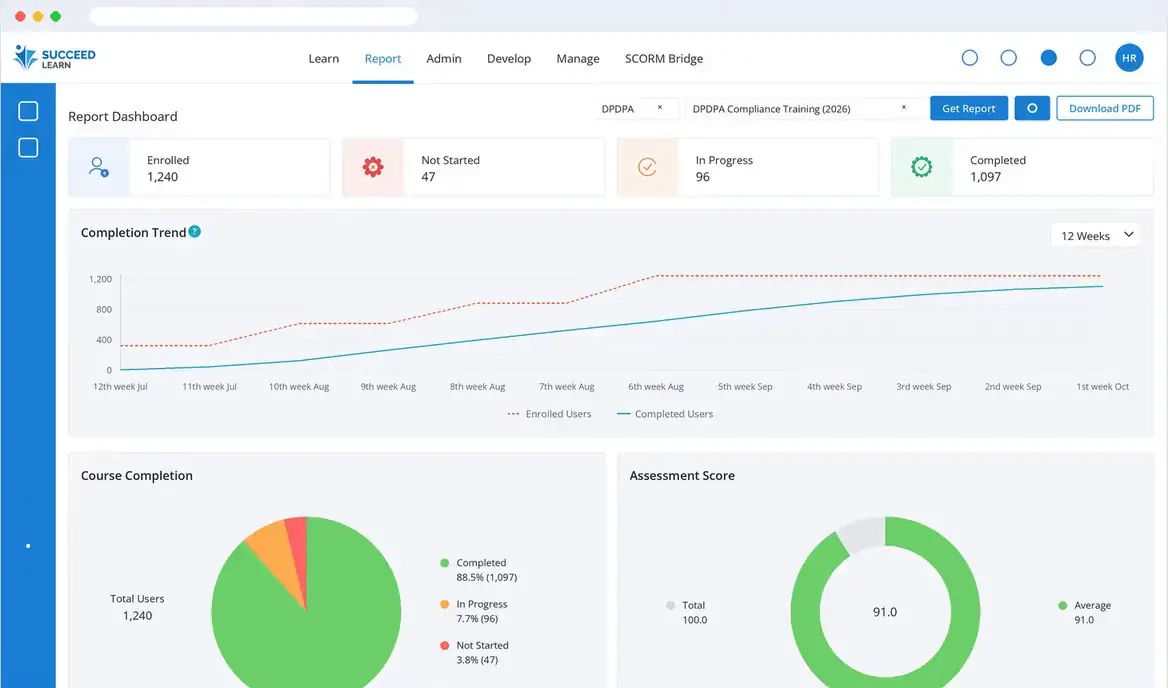
Scores and status for every team, at a glance.
Automatic nudges for anyone who hasn’t started.
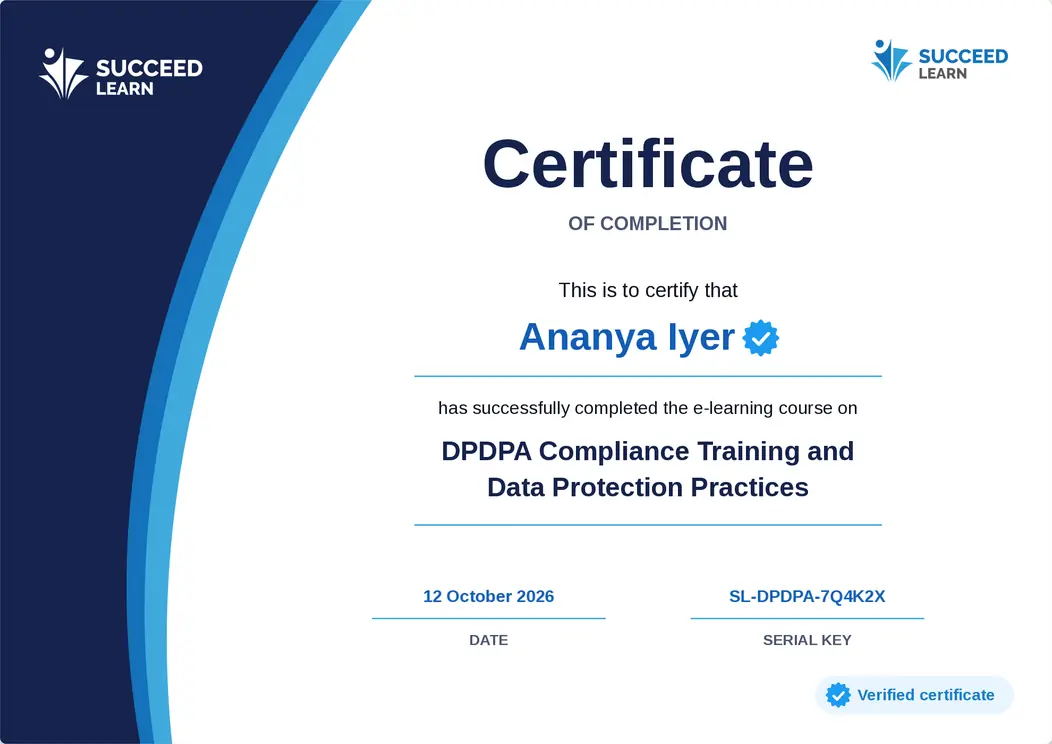
Issued automatically after passing, as a record of course completion.
Our LMS, or a SCORM file for yours.
Duration
Self-paced
Audience
All functions, foundational level
Format
Real workplace examples
Interactions
Reveal cards, drag-and-drop, scenarios
Assessment
From a larger question bank
Certificate
Issued automatically on passing
Delivery
Ours or yours
Built on
With context on the Rules, 2025
10 of 25 spots open
A clear path from understanding the law to proving your team has learnt it.
What the law is and why it matters
Introduction and objectives
Why data protection matters
What is the DPDPA?
Key DPDPA terms
Scope of the DPDPA
Using data the right way, every day
Lawful grounds for processing
Privacy by design
Handling data across its lifecycle
Rights, requests and incidents
Data Principal rights and requests
Grievances and escalation
Breach awareness and reporting
Responsibilities and certification
Your responsibilities
Final assessment and certificate
Answer 15 short questions about how your people handle personal data. See your score straight away, your biggest gaps and a 30-day action plan. No email needed to see your results.
Still have a question? Your 20-minute demo is the fastest way to get answers for your organisation.
People often search for it as India's data privacy law or the Data Protection Act. Its full name is the Digital Personal Data Protection Act, 2023, shortened to DPDPA or the DPDP Act. It sets the rules for how organisations collect, use, share, store and delete personal data.
Yes. The Act covers personal data in digital form, including employee records such as payroll, attendance and HR files, not only customer data. Any organisation that processes it needs to follow the rules.
The DPDP Act, 2023 does not name a specific course. It does require organisations to take reasonable security safeguards to protect personal data, and trained employees are one of the most practical ways to show those safeguards are in place. Penalties for certain failures, such as not taking reasonable safeguards against a breach, can reach ₹250 crore.
Key DPDPA terms, what counts as personal data, lawful grounds and consent, privacy by design, handling data from collection to deletion, Data Principal rights, grievances and breach reporting, followed by a short final assessment.
About 25 minutes. It is self-paced, so employees can finish in one sitting or across a few short sessions.
Yes. Upload it to your existing LMS as a SCORM package, or run it on the SucceedLEARN LMS with ready-made reports and reminder emails.
Learners work through interactive checks, then a final assessment drawn from a larger question bank, with a score of 80% needed to pass. A certificate of completion is issued automatically on passing. On our LMS you get completion reports by department; with SCORM, completion and score are recorded in your own LMS.
Yes. The first 25 customers get up to 10 minutes of course content customised free, including their own policies, examples and branding. This includes your logo and policy in the course, a branded learning portal, and dedicated support throughout your journey, whenever you need help.
The course is built around the DPDP Act, 2023. The DPDP Rules, 2025, notified in November 2025, add procedural detail such as timelines and notice formats. Your internal processes can be reflected through customisation.
We walk you through the course, the interactive activities, the certificate and the admin reports, and answer questions about rollout for your headcount. No preparation is needed.
Prefer email? Write to sales@succeedtech.com