California
Covered employers generally provide at least one hour of training to nonsupervisory employees and two hours to supervisors every two years.


An employee receives an inappropriate message. A witness is unsure whether to intervene. A supervisor hears a concern during a one-to-one conversation. Each person needs practical guidance, but their responsibilities are not the same.
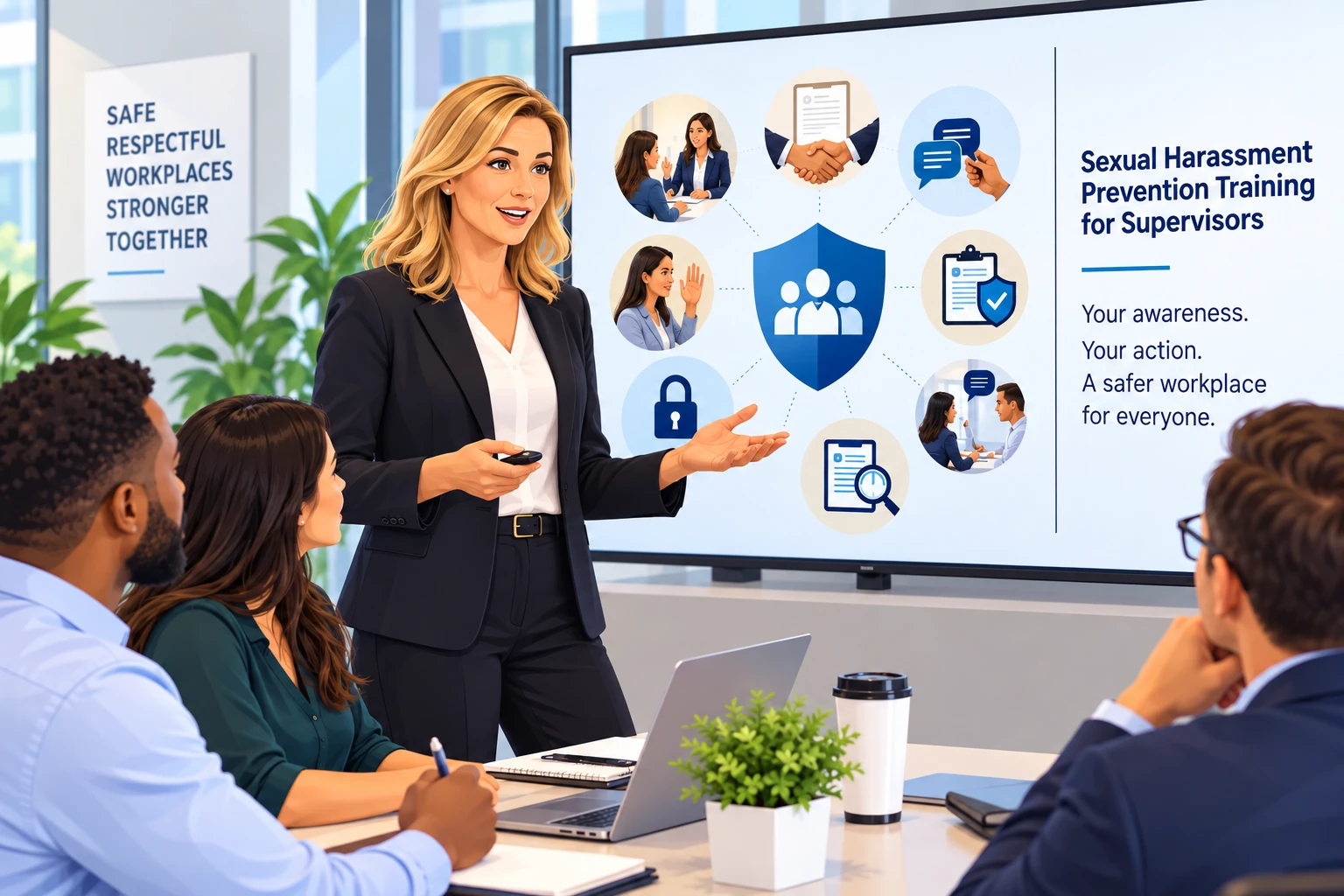
SucceedLEARN’s online US Sexual Harassment Prevention Training provides separate learning paths for employees and supervisors. The courses explain federal principles, workplace expectations and selected state and local requirements through clear examples, scenarios and knowledge checks.
Assign training according to where employees work, whether they supervise others and the requirements that apply to your organization.
Recognize the conduct. Understand the responsibility. Know what to do next.

United States harassment prevention training should help employees identify prohibited and inappropriate conduct, understand how concerns can be reported and recognize protection against retaliation. Supervisor learning should add guidance on policy enforcement, mandatory escalation, complaint handling, documentation, privacy and cooperation with investigations.
The right course also depends on location. Federal anti-discrimination principles operate alongside state and local rules, which may specify who must be trained, the required duration and frequency, interactivity standards or recordkeeping obligations.
At federal level, Title VII of the Civil Rights Act prohibits employment discrimination based on sex and other protected characteristics for covered employers. Federal law does not create one universal harassment-training timetable for every private employer, but effective prevention, reporting and corrective practices remain important parts of workplace risk management.
Several jurisdictions impose more specific training duties. Examples include:
Covered employers generally provide at least one hour of training to nonsupervisory employees and two hours to supervisors every two years.
Employers provide annual interactive sexual-harassment prevention training that meets the state’s minimum standards.
Covered employers provide annual sexual-harassment prevention training; additional rules may apply in particular industries or locations.
Requirements vary according to employer size and supervisory status.
Covered employers train new employees and provide additional information to supervisory and managerial employees.
Other state, city and territorial rules may also apply. Requirements can change, so employers should verify current obligations for each work location and obtain legal advice where appropriate.


The employee course builds awareness of conduct, reporting options and workplace protections. Learners explore:
The supervisor course addresses the additional responsibility that comes with authority over people or employment decisions. It includes:
| Decision Point | Employee Course | Supervisor Course |
|---|---|---|
| Primary purpose | Recognition, reporting and bystander awareness | Prevention, escalation and complaint response |
| Typical learner | Nonsupervisory employee | Supervisor or manager |
| Added focus | Workplace protections and response options | Authority, liability, documentation and follow-up |

Harassment is not limited to a physical office or a single type of interaction. Course scenarios can help learners consider conduct in meetings, email and chat, video calls, client locations, business travel, work events and remote or hybrid environments.
Learners examine how context, frequency, severity, authority and impact can affect the assessment of conduct. They also learn that an organization’s policy may set behavioral expectations that are broader than the minimum legal threshold.
The course catalogue includes federal content and selected jurisdictional material, including California, Connecticut, Delaware, Maine, New York, Illinois, New Jersey, Washington, D.C., Puerto Rico and Washington State. Availability and coverage should be confirmed when the organization’s learner population is mapped.
For each assignment, check the employee’s actual work location, role, required duration, recurrence, interactivity, language, accessibility and recordkeeping needs. Multistate employers may require more than one configuration.
Relevant organizational details help learners connect course concepts with the process they should actually follow. Depending on the selected course and project scope, customization may include:

SucceedLEARN can help your organization determine which employee and supervisor paths align with the workforce information you provide.
Courses can be delivered through the SucceedLEARN LMS or, where supported, as SCORM-compatible packages through an existing learning management system. Mobile and desktop access, assessments, certificates and completion reporting depend on the selected course and delivery configuration.
There is no single training schedule that applies identically to every private employer nationwide. Federal principles operate alongside state and local mandates. Requirements depend on factors such as work location, employer size, industry and role.
Not necessarily. Nonsupervisory employees and supervisors may need different content or duration. Course assignment should reflect work location and actual responsibilities.
Supervisors may receive complaints, make employment decisions, trigger employer responsibilities and need to prevent retaliation. Their training therefore includes escalation, documentation, privacy, investigation support and policy-enforcement responsibilities.
The course addresses sexual harassment and may also cover harassment linked to other protected characteristics, stereotyping, abusive conduct and related workplace expectations, depending on the selected learning path.
Yes, subject to the selected platform and technical configuration. Employers should still verify whether the applicable jurisdiction specifies interactivity, timing, language, accessibility or other delivery standards.
Customization may include policies, reporting channels, contacts, branding and selected workplace examples, depending on project scope.
No. Training can support a prevention and compliance program, but it does not replace current legal advice, effective policies, accessible reporting, impartial investigations, corrective action or protection against retaliation.
Employees should know how to recognize concerns and use available reporting options. Supervisors should know how to receive, document and escalate concerns appropriately.
Choose online United States sexual harassment prevention training based on location, role and applicable requirements.