
- Animated Videos
- Short slides with narrated text
- Interactive scenario exercises
- Real-life case examples
- Frequent knowledge checks / quizzes
- Final assessment and certificate generation
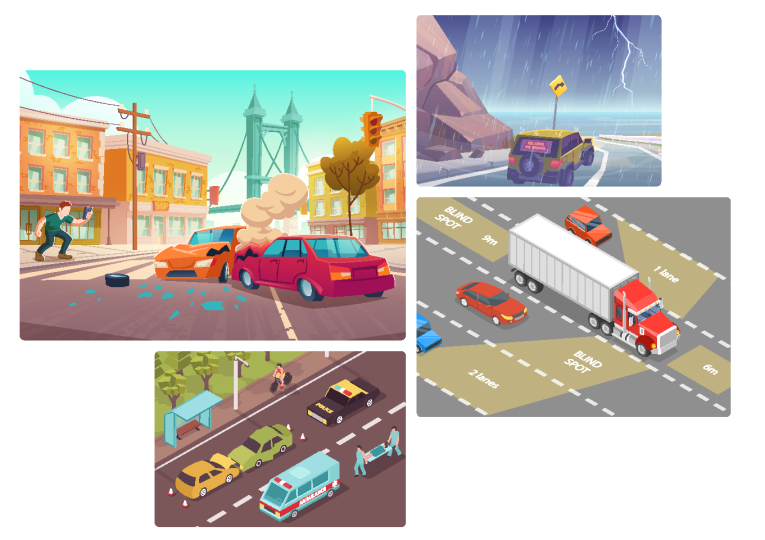
Learning Objectives
By the end of the course, the learners will be able to:
- Identify human, vehicle, and environmental causes of road accidents
- Apply the principles of defensive driving in real-world scenarios
- Understand and recall the Eight Commandments of Defensive Driving
- Demonstrate knowledge of key Defensive Driving Competencies and Skills
Why Generalized Defensive Driving eLearning Training?
Fulfil Your Legal Duty of Care
Defensive driving training is mandatory for certain professional driver categories such as US CDL holders, EU/German CPC drivers, Singapore vocational licensees, UAE school-bus and taxi drivers, and Brazil’s regulated commercial drivers.
Under employer duty-of-care and workplace health and safety (WHS) obligations in countries like the UK, Canada, Australia, South Africa, and India, defensive driving training serves as a compliance-aligned best practice for employees who drive as part of their job, helping orgs reduce risk and uphold safety standards.
Aligns with globally recognised accident-prevention frameworks (Haddon Matrix)
By applying the Haddon Matrix (pre-event, event, post-event across human, vehicle, and environment factors), the training reflects a structured, internationally accepted safety model. This demonstrates to regulators, auditors, and insurers that the org adopts a systematic and proactive approach to accident prevention rather than reactive compliance.
Scenario-driven learning that mirrors real work conditions
Interactive scenarios on tailgating, blind spots, night driving, adverse weather, and high-risk environments (including site and mining conditions) ensure employees can apply safety principles on the job, not just recall rules.
Protects employees, business continuity, and organisational reputation
Beyond compliance, the training acknowledges the human and social impact of road accidents on employees and their families, reinforcing why safe driving is a shared responsibility. Fewer incidents translate into lower downtime, reduced insurance costs, fewer legal claims, and stronger employer reputation.
Improve Compliance and Reputation
Offering road safety training shows your org’s commitment to employee wellbeing and corporate responsibility. This not only strengthens your compliance posture but also enhances your public image as a responsible employer.
Customize It for Your Org
The course can be tailored to your branding, policies, and vehicle safety standards, making it seamlessly fit into your org’s learning ecosystem and safety culture.
Course Structure
Learning elements
Format & accessibility
The platform features responsive design for seamless use on desktop, tablet, and mobile devices, along with a learner dashboard that tracks progress, sends automated reminders, and integrates effortlessly with your existing systems for smooth management.
Certificate
On successful completion and passing the assessment, learners can generate a completion certificate as proof of training (configurable per org).
Target Audience
The course is tailored for:
- Employees who drive as part of their job (company vehicles, fleet, or grey fleet)
- Field staff, sales teams, service engineers, and technicians travelling between sites
- Logistics, transport, and delivery personnel, including light and heavy vehicle drivers
- Employees operating vehicles in high-risk environments (sites, plants, mining, remote locations)
- Supervisors and line managers responsible for driving safety and incident oversight
- Contractors and third-party drivers engaged on behalf of the org
Case Studies: Real Consequences of Non-Compliance
While defensive driving training is not explicitly mandated by name in most jurisdictions, employers are legally required to manage work-related driving risks.
This matters for employers because absence of training is often cited after accidents and Courts and regulators assess whether the employer took reasonable steps.
Below is how the U.S. considers the course of action and a case in the UK:
- In the U.S. courts commonly apply vicarious liability where an employer may be responsible for an employee’s negligent driving during work duties - e.g., delivery routes, client visits, company errands - leading to civil liability, large damage awards in lawsuits, and higher insurance costs when employers fail to train or supervise drivers properly.
- In the UK, Bestway Northern Limited was fined £1 million after a worker directing a reversing HGV was fatally crushed during a delivery. HSE (Health and Safety Executive) found the company failed to implement a safe system of work, conduct proper risk assessment, or provide adequate training for employees acting as banksmen on site.
Course Outline
Causes of Road Accidents
- Human Factors
- Vehicular Factors
- Environmental Factors
- Activity: A quick activity to test the learner’s understanding about the different causative factors of an accident.
Haddon Matrix
Defensive Driving
Eight Commandments of Defensive Driving
Scenario: Select the vehicles which are present in the blind spot area of the truck.
Driving Skill Points
Tips at each stage of driving:
- Before Starting
- During Driving
- Driving at Night
- Before Stopping
- After Stopping
See how Succeed will work for your Organization

FAQs
Defensive driving is a proactive driving approach focused on anticipating risks, avoiding hazards, and making safe decisions to prevent accidents, even when other road users make mistakes.
It involves maintaining awareness of surroundings, following safe speeds and distances, anticipating potential dangers, and applying safe driving techniques to reduce the likelihood and severity of collisions.
This course equips employees with essential road-safety knowledge and practical defensive driving techniques to minimise preventable accidents, anticipate risks, and make responsible decisions behind the wheel, both on and off the job.
The course focuses on the key drivers of workplace road incidents, including distraction, speeding, tailgating, blind spots, impaired driving, fatigue, poor decision-making, and adverse environmental conditions. By targeting these risks, employers reduce the likelihood of preventable accidents and associated legal, financial, and reputational exposure.
Work-related road incidents are a major cause of employee injuries and operational losses. Defensive driving training helps orgs reduce accident risks, safeguard employees, protect assets, and demonstrate compliance with workplace health and safety obligations.
The training is ideal for all employees who drive as part of their job or commute regularly, as well as managers, field staff, and fleet drivers. HR and safety teams can also benefit by understanding how to promote safer driving practices organization-wide.
The course applies the Haddon Matrix, a globally recognised accident-prevention framework, covering pre-event (prevention), event (injury reduction), and post-event (incident response) stages. This aligns with regulatory expectations that employers take a systematic and proactive approach to managing safety risks, including work-related driving.
Yes. In addition to public-road driving, the training addresses high-risk work environments such as sites, plants, mining operations, poor infrastructure, night driving, extreme weather, and long working hours. This ensures employees can apply defensive driving principles in real-world operational settings relevant to the employer’s business.
The course helps build a culture of safety and accountability, reduces absenteeism and insurance claims, and supports compliance with duty-of-care requirements under health and safety legislation. It also enhances an org’s reputation for employee wellbeing and responsibility.
The course can be completed in just about 40 minutes, making it easy to integrate into busy work schedules while ensuring high learning impact.
Providing defensive driving training demonstrates that your org takes proactive steps to minimize risk and protect employees, fulfilling duty-of-care and occupational health and safety responsibilities.
In Canada, employers face significant legal consequences under the Motor Vehicle Transport Act and the National Safety Code (NSC) for their role in work-related motor vehicle accidents.
To prevent such risks, several regions, including Canada and the European Union, have implemented compliance training programs aimed at enhancing driver skills and reducing road accidents through greater awareness and safer driving practices.
Yes. The content can be tailored to include your org’s policies, driving standards, and safety procedures, ensuring it aligns with your culture and operational needs.
Orgs can expect a measurable reduction in accidents and claims, improved driver behavior, heightened safety awareness, and stronger compliance with corporate and legal standards.
The delivery is fully flexible. If you have an in-house LMS, we can provide the course as a SCORM-compliant package. If not, we offer a seamless SaaS-based hosting option for easy access and deployment.